


FPG celebrates 60 years, looking back at the FPG child care center
To help celebrate the 60th anniversary of the UNC Frank Porter Graham Child Development Institute (FPG), we will be looking back at stories that highlight FPG’s history, its people, and some of the incredible work accomplished within the Institute over the past six decades. This piece, from FPG’s Early Developments discusses FPG's child care center and how it was a model for inclusion.
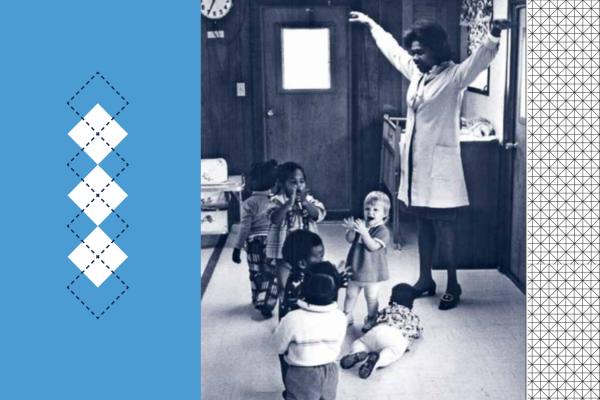
In 1966, FPG launched a child care program designed as a foundational step for an extensive research project examining how full-day early education, health care, and social services affect disadvantaged children's lives. Graduates from this original cohort of children, all of whom are now well into adulthood, have been consistently followed by FPG researchers.
FPG’s child care center earned national accreditation from the National Association for the Education of Young Children, and became known for its inclusive environment, serving children with disabilities alongside those from diverse socioeconomic backgrounds. It focused on four main goals: serving children and families in the community, conducting research, providing demonstrations, and supporting professional development.
Over its 47-year history, the child care center played a role in raising generations of North Carolina residents and supported nationally recognized research in early childhood education and the professional development of child care teachers and therapists, serving as a "demonstration site" for best practices in early childhood education.
Although the child care center closed 13 years ago, its lengthy legacy continues through modern initiatives at the Institute. We are proud of the role the child care program played in our community, particularly in serving children with disabilities and families experiencing poverty.
Originally Published in FPG’s Publication, Early Developments Spring 2002, Volume 6, Number 2, pages 15-17
A Model of Inclusion
With the 1975 passage of the Education of Handicapped Children Act, and its reauthorization in 1990 and 1997 as the Individuals with Disabilities Education Act (IDEA), Congress called on states to embark on a bold effort to incorporate children with disabilities into the mainstream of education. That effort has met with mixed results nationwide, but at the FPG child care center, inclusion of children with disabilities has been the norm since 1984. Results of that effort suggest that inclusion can be beneficial for both children with disabilities and those who are typically developing.
Housed in the first two floors of FPG, the child care program serves 80 children ranging in age from 6 weeks to 5 years old. It is a full day program, operating from 7:30 am to 5:30 pm and open year-round. Approximately 30% of the children within each age group have an identified disability, with slightly more children with disabilities enrolled in preschool classrooms than in the infant-toddler groups. A diverse range of types and severity of disabilities are represented, including Down syndrome, cerebral palsy, other specific syndromes, children who are medically fragile, and autism.
The program is accredited by the National Association for the Education of Young Children and has a five-star North Carolina license—the highest quality rating in the state. Teachers at FPG tend to be more educated than is typical of child care providers in the community, with most having a four-year degree, and many having a North Carolina Birth-to-Kindergarten teaching license, according to P.J. McWilliam, who directs the center.
“A more educated staff and lower child-to-adult ratios leads to more engaging and developmentally- appropriate activities going on in the classrooms,” McWilliam says. “Teachers’ interactions with children tend to be more positive, aimed at facilitating social-emotional development rather than merely controlling undesirable behavior.”
While they may hold degrees and licenses, few teachers enter the program with extensive experience in working with children with disabilities. “A lot is learned on the job,” McWilliam adds.
Although a team of specialists supports each child’s developmental progress and inclusion, children at FPG are not pulled out of their classrooms for therapy. Instead, specialists share their expertise through consultation with teachers and, less frequently, through direct intervention within the context of classroom routines. These routines include morning circle, mealtimes, outdoor play, pretend play, storybook reading, and field trips.
The role of specialists and the purpose of therapy are to enable each child to participate in the regular early childhood curriculum and to support his or her membership in the group. “The fact that children stay with the same group of buddies for at least their first three years of enrollment at FPG helps,” McWilliam says.
Team approach
FPG’s approach to special services relies heavily on teaming. The program is fortunate to have an on-site special services staff, which consists of a service coordinator (special educator), a speech-language pathologist, an occupational therapist, a physical therapist, and a behavior analyst.
“Although some of our specialists only work part- time for the program, the consistency in who works with the children and teachers makes a big difference,” McWilliam says. “Regular and effective communication among members of the special services staff and, perhaps more importantly, between the special services staff and the classroom teachers is critical. Stolen moments during a specialist’s visit to the classroom, a chance encounter in the teacher’s lounge, or a few words shared out on the play yard allow for informal communication and intervention updates with teachers.”
Additional time, however, is required for more in-depth communications about children’s progress and needs. The special services staff try to meet more formally with each teacher at least every other week for an hour or so to discuss the children. In addition, formal individualized education plan (IEP) meetings and individualized family service plan (IFSP) meetings are scheduled for each child, along with meetings to review and update these plans.
Partnership with parents
Child care center staff emphasize that effective parent-teacher partnerships are a key factor in meeting the needs of children with special needs, as well as those of children who are typically developing. The cornerstone of these partnerships is honest and ongoing communication. This can take many forms, from informal chatter at the beginning or end of the day to more formal parent-teacher conferences. Short notes about the child’s day that are stuck in a diaper bag or cubby, as well as e-mail messages or evening phone calls are other good communication techniques. “The more open, honest, and frequent the communication, the more effective the partnership will be between parent and teacher,” McWilliam says. “The same holds true for relationships between specialists and parents.
In fact, parents of children at FPG actually lead the team in identifying appropriate goals and priorities for intervention with their child. Over the past year, the program has adopted a routines-based approach to intervention planning whereby the skills and behaviors that children need to be successful in their daily routines are the focus of the intervention plan. This has helped to ensure that parents’ values and priorities are clearly communicated to the team and that parents actually direct the design of interventions for both home and classroom.”
Parents of children with special needs are also encouraged to be involved in classroom activities in the same ways as parents of typically developing children. This may mean joining the class during morning circle time, going on a field trip, volunteering in the classroom, attending classroom potluck dinners, or attending FPG’s parent advisory board. These parents, like all other parents in the program, are free to choose the type and level of involvement that they find meaningful and that fits into their busy schedules.
A touch of magic
Research suggests that parents of children with special needs and those who are typically developing have concerns as to whether the benefits of an inclusive classroom setting outweigh the drawbacks. The experience at the FPG child care center, as well as wider research in the field, suggests that benefits do outweigh the drawbacks.
“Research has shown that in high-quality child care settings, there are clear benefits from inclusion,” says Don Bailey, director of the FPG Child Development Institute. “First, children with disabilities and those without do play together. Second, children with special needs engage in more social behavior in inclusive settings than they do in segregated settings. Third, there are no negative consequences for typically developing children placed in inclusive settings. To the contrary, these children develop an appreciation for the differences.”
McWilliam admits that even in programs like FPG’s, where resources are more plentiful than others, inclusion isn’t always easy, nor is it inexpensive. But witnessing the benefits makes the effort worthwhile.
“There’s a little boy named Jake in one of our two- year-old rooms who has severe and multiple disabilities,” McWilliam says. “He has been in our program, and with the same group of children, since he was an infant. Despite the fact that Jake can’t do many of the things that the other children in the classroom can, it is clear from watching and listening to the other children that they consider him a true member of their group. They always notice when he’s out sick and they insist upon his name being included in any conversations about the group. They have always approached him readily to play with the adaptive toys on the tray of his wheelchair or special seat and they encourage Jake to activate them, too—after they’ve had their turn first, of course!”
“One day last week,” continues McWilliam, “I was in this same classroom and noticed Jake lying on the floor under a cross bar with toys suspended from it. Another 2-year-old, Demarcus, had joined him under the crossbar and was lying cheek to cheek with Jake, trying to tuck a doll blanket under both of their chins. Demarcus wasn’t doing this for adult attention,” explains McWilliam, “His affection for Jake seems quite sincere. It’s heartwarming to witness.”
“There have been times,” admits McWilliam, “when I’ve wondered what the children with more severe disabilities get out of being in our program … whether it really matters to them that they are in a setting with typically developing peers. Again, there are a few moments here and there that make me realize that the answer is yes.”
“One day Jake wasn’t feeling well,” says McWilliam, “so I offered to take him for a walk around the halls in his stroller. As I rounded a corner, his buddy Demarcus burst through the front door, saw Jake in his stroller, and immediately started talking to him. Jake’s crying stopped almost immediately and he started to coo. It seemed clear to me that Jake recognized the sound of his friend’s voice, that it comforted him in some way, and that he appreciated and benefited from their relationship—albeit in his own manner.”
“We all benefit from inclusion,” McWilliam adds. “But some of the most important benefits have nothing to do with IQ scores or later school achievement. Perhaps someday, these less clearly measurable outcomes will be understood to be of greater value.”


