


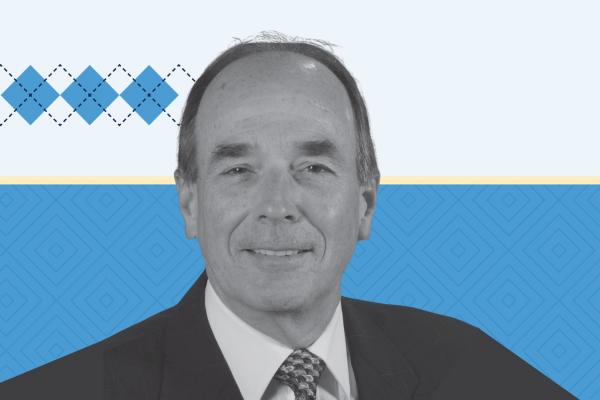
FPG Celebrates 60 years, reflections from Samuel Odom
In recognition of the 60th anniversary of the UNC Frank Porter Graham Child Development Institute (FPG), we are creating and curating content to showcase the Institute’s history, its community, and their significant contributions and achievements over the past 60 years. A series of interviews featuring four former directors and the current director provides insight into the personal and professional impact of leading the Institute.
In this installment, we hear from Samuel Odom, PhD, who served as FPG’s director from 2006 until 2017. Odom is a senior research scientist at FPG and a research professor emeritus in the UNC School of Education. He is the author or co-author of more than 200 publications and editor or co-editor of more than 10 books on early childhood intervention and developmental disabilities. While his research has addressed topics related to early childhood inclusion and preschool readiness, currently his work focuses on autism spectrum disorder (ASD).
Odom served as a member of the National Academy of Sciences Committee on Educational Programs for Young Children with Autism, contributing to a comprehensive report on effective educational strategies for children with ASD. He also participated in the committee responsible for developing the 10-Year Roadmap for Autism Research, coordinated by the National Institute of Mental Health and the Interagency Autism Coordinating Committee. His recent research publications have examined the effectiveness of various focused interventions for children with ASD, including peer-mediated, sibling-mediated, parent-mediated approaches to enhance joint attention, and independent work systems designed to support learning.
What did it mean to you to serve as FPG’s director?
I want to say that I never had aspirations to be an administrator, like a dean or a provost. But, the opportunity to be a leader of FPG was such a great chance to both provide leadership and to continue my research program.
I was able to do both when I was at FPG thanks to the colleagues that I had there and in the administrative support that I received from Greg Burress as associate director for the business office, and a set of associate directors for research. Donna Bryant, Kelly Maxwell, Iheoma Iruka, and Desiree Murray all provided just huge support for the research that was occurring at the time. And I was fortunate to have great, great colleagues, and still have great, great colleagues. Starting with a young postdoc at the time, Brian Boyd, and others that joined our research program—Kara Hume, Ann Sam, Ann Cox, Deborah Hatton, Jessica Steinbrenner. And just a host of other individuals that contributed to the research that we were doing at the time.
If you could only share one thing about FPG, what would you tell someone?
The single thing that I would share is, our motto sort of says it all: Advancing knowledge to transform children's lives. I might expand it to go beyond children to adolescents and adults because we work with teachers. But, at FPG, I am so proud that we contribute to very rigorous science, and we translate that science into practices that teachers use in classrooms and in child care centers and that benefit children and their families.
From your perspective as a former director, what are your hopes for FPG over the next 60 years?
My hopes for the next 60 years are just to continue and to grow the good work that we're doing. I think FPG is still exemplary as a research institute. And I'm just super hopeful and optimistic that we will continue over that next 60 year period.


