


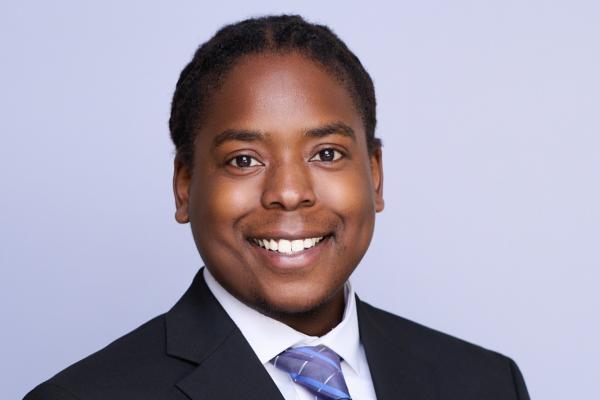
FPG student profile series: TK Musa
TK Musa, a former graduate research assistant with the Equity Research Action Coalition at the UNC Frank Porter Graham Child Development Institute (FPG), was born and raised in Malawi before moving to the United States to pursue higher education. He earned his bachelor's degree in economics from Rutgers University and recently completed a PhD in Public Policy at the University of North Carolina at Chapel Hill, where his academic work centered on education and social policy.
Across his academic career, Musa has focused on how education systems can expand opportunities for children to thrive, especially children and families historically underserved by those systems. His research uses both quantitative and qualitative methods to examine educational equity, child development, and the ways culture, policy, and community shape learning.
After graduating from Carolina, Musa joined NCEE as a research analyst. Musa’s current work examines how high-performing education systems are designed, implemented, and continuously improved, with particular interests in assessment, accountability, and the responsible use of artificial intelligence in education.
As part of our FPG student profile series, we recently spoke with him to learn more about how he came to be at FPG and his work here at the Institute. Here’s what he had to say.
Tell us about how you came to work at FPG and about the work you do here.
I first connected with FPG after Dr. Iheoma U. Iruka presented her research at one of the Public Policy Program's Policy Research Group seminars. Her work on educational equity and early childhood development resonated deeply with my own interests, and after the presentation I reached out to learn more about her work. That conversation ultimately led to joining the Equity Research Action Coalition (ERAC) as a graduate research assistant.
During my time at FPG, I worked across a range of projects focused on improving early childhood systems through research and partnership. My work included qualitative interviewing, mixed-methods research, data analysis, project coordination, and translating research findings into practical tools for educators, families, and policymakers. I also contributed to studies examining African-centered education, family decision-making in early childhood education, implementation research, and community partnerships designed to improve educational opportunities for young children.
Can you share some key takeaways of things you've learned working with your project team?
One of the biggest lessons I learned is that producing rigorous research is only part of the job. Equally important is ensuring that the research is useful to the people who can act on it.
Working alongside our team showed me how strong partnerships with educators, families, practitioners, and community organizations make research more relevant and ultimately more impactful. I also learned the importance of approaching research with humility and recognizing that communities bring expertise that complements academic knowledge.
Finally, I gained a much deeper appreciation for interdisciplinary collaboration. Some of our most meaningful work happened because researchers with different methodological backgrounds and lived experiences worked together toward a shared goal.
What impact has working at FPG with your project team had on your academic and career pursuits?
My experience at FPG fundamentally changed how I think about research.
Before joining ERAC, I primarily viewed research through an academic lens. Working alongside the team showed me how research can directly inform policy, improve professional practice, and strengthen communities. Whether supporting the African-centered Working Collaborative, partnering with Educare schools, collaborating with Parents as Teachers National Center, or helping develop self-reflection tools for practitioners, I saw firsthand how evidence can move beyond journal articles into real-world implementation.
Those experiences significantly shaped my career aspirations. During my job search, I realized I wanted to work at the intersection of research, policy, and implementation—where rigorous evidence can inform large-scale systems improvement. That perspective ultimately led me to my current role as a Research Analyst at the National Center on Education and the Economy (NCEE), where I study high-performing education systems and their implications for education policy. Looking back, I can see that many of the experiences that prepared me for this role began at FPG.
What are you particularly proud of accomplishing?
One accomplishment I'm particularly proud of was contributing to a collaborative line of research on African-centered early childhood education that continued to grow beyond our initial publication. Our team's work led to an invitation for me to return to my alma mater, Rutgers University–New Brunswick, to present on the project and discuss its implications for educational equity. Building on that work, I also contributed to the development of a Spencer Foundation grant proposal that seeks to better understand why Black families choose African-centered early learning programs and how those experiences shape children's development. Seeing a collaborative research agenda evolve from published findings into new partnerships and funding opportunities has been especially rewarding.
Please tell us more about your work with the Equity Research Action Coalition.
My final projects with the Coalition focused on supporting implementation and continuous improvement efforts with community partners. One involved contributing to a new phase of the Parents as Teachers National Center partnership, which expanded pilot testing of a self-reflection tool and accompanying facilitation resources designed to support conversations around healthy identity development among families and home visitors. The project also included the development of implementation guides and training materials to support broader adoption across affiliates.
"My experience at FPG fundamentally changed how I think about research."
Alongside this work, I contributed to the development of a Spencer Foundation proposal examining Black families' motivations for enrolling their preschool-aged children in African-centered early learning environments. Building on our earlier work, the proposed mixed-methods study seeks to understand how families make educational decisions and how African-centered education supports children's academic and socio-emotional development.
Although I have now transitioned to NCEE, I hope to continue collaborating with colleagues at FPG whenever opportunities arise. The relationships and experiences I developed through the Coalition have had a lasting influence on how I think about research and its role in supporting children, families, and communities.
Can you tell us about your dissertation?
My dissertation, Cultural and Economic Foundations of Educational Equity in the African Diaspora, examined how cultural and economic systems shape educational opportunities for Black children across global contexts.
The first two studies explored African-centered early childhood education in the United States, examining both how these programs are implemented and why Black families choose them. The third study evaluated the long-term educational effects of Zambia's Child Grant Program, one of Africa's largest unconditional cash transfer programs. Taken together, these studies suggest that educational equity requires attention not only to economic resources but also to culturally affirming learning environments that foster belonging, identity, and opportunity.
Do you have any advice for future graduate students?
One piece of advice I'd offer graduate students is to be intentional about seeking opportunities that stretch your skills beyond your dissertation. Some of the most meaningful experiences I had at FPG involved collaborating across disciplines, engaging directly with communities, developing practical tools, presenting research to practitioners, and learning how evidence moves into policy and practice.
Those experiences not only made me a stronger researcher—they also prepared me for a career beyond academia. FPG creates an environment where students can see how rigorous research can have meaningful impact, and I'm incredibly grateful to have been part of that community.


