


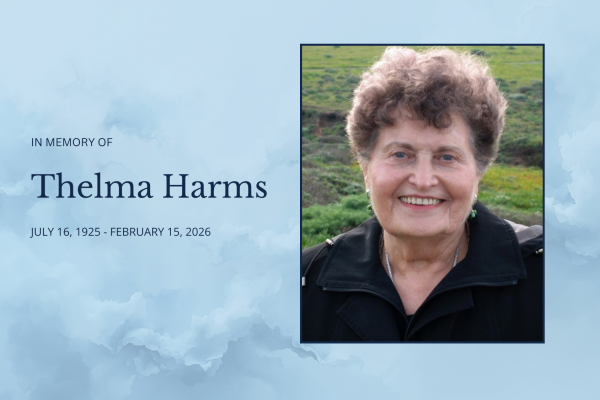
Thelma Harms, former director of curriculum development at FPG, dies at 100
Thelma Harms, PhD, a pioneering early childhood educator and researcher whose close observation of classroom life helped shape standards for early childhood education programs around the world, died on Feb. 15, 2026, in Los Angeles. She was 100.
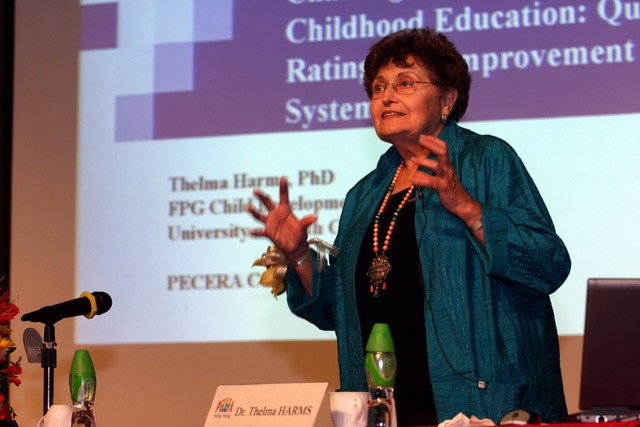
Harms was widely known as the lead co-author of the Early Childhood Environment Rating Scale (ECERS), an observational framework that transformed how educators, researchers and governments evaluate early learning settings. Developed during her tenure as director of curriculum development at the Frank Porter Graham Child Development Institute at the University of North Carolina at Chapel Hill, the ECERS—created with co-authors Richard Clifford and Debby Cryer—became one of the most widely used measures of early childhood program quality worldwide. It provided a standard definition of quality in early childhood care and education classrooms, facilitating a vast increase in research, evaluation and professional development during a time of rapid proliferation of such programs in the United States and beyond.
Born in Manhattan on July 16, 1925, Thelma Harms was the eldest daughter of Benjamin and Ida Ostrowsky, both immigrants from what is now Belarus. She graduated from Brooklyn College and earned master’s degrees in English Literature and German from the University of Wisconsin–Madison. She married the artist Norman L. Harms in 1946, who predeceased her.
Harms’ path to global influence began in a personal search for a suitable part-day preschool for her oldest son in the early 1950s. Visiting programs across her community, she began taking notes about available materials, how children interacted with them, and the relationships among teachers, children and parents. Those handwritten observations evolved into a larger idea: that observing the everyday experiences of children in classrooms could help educators improve them. The resulting framework gave educators and policymakers a shared language for understanding and strengthening program quality, shaping evaluation systems, teacher training and public investment in early learning for decades.
Classroom teaching shaped both her intellectual interests and practical outlook. While pursuing a master’s degree in child development at the University of California–Berkeley, she taught at the Berkeley Public Schools Parent Cooperative, working closely with families from diverse cultural and economic backgrounds—an experience that deepened her belief that educational environments reflected community values as much as instructional philosophy.
From 1959 to 1975 she served as head teacher at the University’s Harold E. Jones Child Study Center, a multidisciplinary laboratory school where she worked alongside graduate students and researchers who regularly observed and challenged classroom practices—an experience she later said helped her articulate why certain environments better supported children’s development. As a doctoral candidate at Berkeley, Harms began developing practical checklists to help teachers observe their classrooms more carefully. Rather than focusing on curriculum alone, she examined how space, materials, relationships and routines shaped children’s experiences. These tools became the foundation of her later work.
In 1975, she joined the Frank Porter Graham Child Development Institute at the University of North Carolina at Chapel Hill as director of curriculum development. There, in collaboration with Richard Clifford, those checklists were developed into a systematic assessment instrument. First published in 1980, the Early Childhood Environment Rating Scale (ECERS) translated research and classroom experience into observable indicators of quality, allowing programs not only to be assessed, but to identify concrete paths for improvement. These indicators ranged from cognitive and social development activities to health and safety provisions. Related scales developed with Clifford, Cryer and later with Noreen Yazejian for infant and toddler care (ITERS), family child-care homes (FCCERS) and school-age programs (SACERS) developed with Donna Romano White, and Ellen Vineberg Jacobs followed, extending the framework across early childhood settings.
The popularity of the scales spread rapidly, and were incorporated into Head Start programs, state quality and improvement rating systems, universal pre-kindergarten initiatives and professional training programs in the United States and abroad. Adopted across cultures, translated into more than 20 languages and employed in over 30 countries, they reflected what Harms viewed as universal principles of child development despite differing educational traditions.
“There is now an increasing belief that quality in childcare can be measured and enhanced in a planned way. The starting point for quality assessment was inspired by Thelma’s work.”
~Wolfgang Tietze, professor at the Institut für Kleinkindpädagogik in Berlin.
Harms expanded her work beyond research audiences. From 1987 to 1990, she helped write and produce Raising America’s Children, a 10-part public broadcasting series developed with the North Carolina Center for Public Television and shown widely in the United States and overseas. She also collaborated with Debby Cryer on the seven-volume Active Learning Series, curriculum materials used in programs serving children from infancy through kindergarten. Dr. Harms also partnered with Cryer in founding the ERS Institute, which provides training for the Environment Rating Scales.
A sought-after speaker, Harms presented at hundreds of conferences and led extensive training workshops on improving classroom quality through observation and reflection. She advised nonprofit organizations, state agencies, universities, military childcare systems and international ministries working to strengthen early education programs.
Her work increasingly took her abroad. The rating scales were adopted in countries across Europe and beyond, including Germany, where she and Clifford conducted seminars introducing educators to the framework. Fluent in German, Harms helped field-test translated versions and worked with local professionals to adapt them to national contexts. Researchers credited her work with encouraging a growing belief that childcare quality could be systematically measured and improved.
“Thelma has made a substantial contribution to research in the United Kingdom on early childhood education and care. Many of us have used ECERS for studying quality across a range of British settings. She has shared her experiences with us from countries around the world and asked the kinds of searching questions that have enabled us to improve our own work.”
~Professor Kathy Sylva, OBE, University of Oxford
Harms continued applying the framework to reform efforts. As co-principal investigator with Lynette Aytch, she helped lead the Quality Care for Children Initiative in Washington, D.C., which trained local professionals to provide on-site coaching to childcare providers and contributed to a significant increase in nationally accredited centers in the District. Colleagues often noted her ability to work across cultural and socioeconomic boundaries. Rather than presenting evaluation as criticism, she framed it as collaboration—a shared effort to help programs better serve children.
Harms never lost her focus on the daily realities facing teachers. She argued that improving early childhood education required stronger preparation, better compensation and safer, more stimulating environments for young children. Great teachers, she believed, created classrooms that encouraged curiosity, independence and creativity.
“I realized my point of view was extremely eclectic. It combined intellectual and social development with freedom to experiment and create. What about the climbing equipment, the books children have available, the art supplies, the music. What about the stories we tell? All of those things provide opportunities for children not only to absorb, but to produce.”
~ Thelma Harms
Harms is survived by her daughter, Rachel Harms of Los Angeles; her sons, Noah Harms and Jesse Harms; and grandchildren Ellen Harms and Nathan Harms.
The family will announce details about memorial gatherings to be held in Chapel Hill, NC, and Berkeley, CA, in the coming months. Those wishing to participate may send their name and contact information to ThelmaHarmsMemorial@gmail.com. In lieu of flowers, donations may be made to the Thelma Harms Early Childhood Education Fund at UNC.


