


For 60 Years, FPG Has Helped Shape What Children Need to Thrive
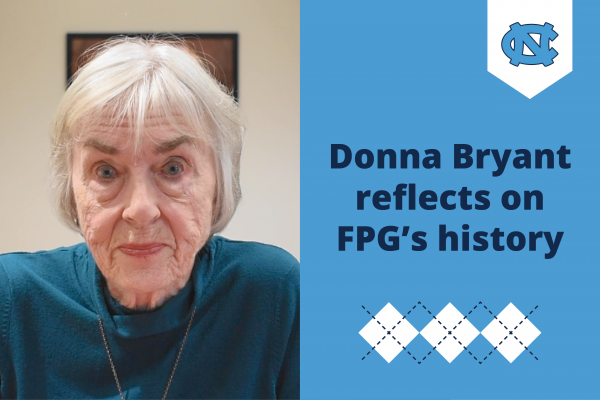
As the UNC Frank Porter Graham Child Development Institute (FPG) celebrates its 60th anniversary, Donna Bryant, PhD, a longtime senior research scientist at the Institute, sat down with us to reflect on the studies, partnerships, and people that have helped define the Institute’s enduring impact on children, families, programs, and policy.
When Bryant looks back across the 60-year history of FPG, she sees more than a collection of landmark studies. She sees an Institute built around a central purpose: generating knowledge that can improve children’s lives—and ensuring that knowledge reaches the families, educators, programs, communities, and policymakers who can put it into action.
“It was the Abecedarian study that really put FPG on the map in the whole child development area,” Bryant said, reflecting on the early research that helped establish FPG’s national and international reputation.
Launched in the 1970s, the Abecedarian Project challenged a common assumption of the time: that placing young children in child care might be harmful to them. Instead, the study demonstrated that high-quality early care and education could support children’s language, cognitive, and overall development. Led by Craig Ramey, PhD, and Joe Sparling, PhD, and grounded in the Learning Games curriculum, the Abecedarian Project became one of FPG’s most widely known and cited contributions to the field. Its findings helped shape Head Start, pre-K programs, and early childhood policy across the country.
For Bryant, the significance of Abecedarian was not only what it proved, but what it made possible. It showed that rigorous research could help answer urgent questions about children’s development while informing systems designed to support children and families. That combination—research with real-world consequence—has been central to FPG’s identity for six decades.
A broader view of child development
Although FPG is often recognized for its contributions to early learning and cognitive development, Bryant emphasized that the Institute’s work has always reflected a broader understanding of what children need to thrive. Health was part of that story from the beginning.
In its early years, FPG researchers studied topics including handwashing, children’s exposure to smoke, and otitis media, or middle ear infections. Later work expanded into areas such as fragile X syndrome. Taken together, Bryant said, these efforts reflected “this undercurrent of work on health issues that face children,” underscoring that children’s development is shaped by cognitive, social, emotional, physical, and environmental factors.
Measuring quality—and helping improve it
Another defining contribution came through the Early Childhood Environment Rating Scale (ECERS), developed by Thelma Harms, PhD, and Richard Clifford, PhD, and the related family of environment rating scales that followed. The tools helped show that quality in early care and education could be observed, measured, and improved.
That shift had far-reaching implications. The rating scales gave states, communities, and programs a way to identify strengths and areas for growth. They helped inform quality rating and improvement systems, including early efforts in North Carolina, and became part of a larger movement to help parents understand program quality while giving educators and administrators practical guidance for improvement.
“Those scales showed that you could quantify quality,” Bryant said, “and you could show where programs needed to improve.”
That practical orientation has carried through decades of FPG work. Studies such as the Cost, Quality, and Outcomes Study and the National Center for Early Development and Learning helped document the quality of child care and pre-K programs and provided evidence that states could use to strengthen early childhood systems. Today, FPG investigators continue that legacy through research and evaluation that help states assess, improve, and sustain early learning programs.
Technical assistance that strengthens systems
FPG’s impact has also been shaped by one of its longest-running bodies of work: technical assistance for early intervention and early childhood special education systems. Beginning with the Technical Assistance Development System, or TADS, FPG teams helped states and communities respond to federal laws and build services for children with disabilities and their families.
Over more than five decades, that work has evolved through multiple national centers and initiatives, while maintaining a consistent focus: helping states understand where they are, identify what they need, and implement practices that lead to better outcomes for children.
The same commitment is visible in the FPG-founded International Early Childhood Inclusion Institute, which has brought early childhood educators, special educators, technical assistance providers, and leaders to Chapel Hill for professional development focused on inclusion for a quarter of a century and counting. Bryant described the Inclusion Institute as a powerful example of FPG’s ability to gather people who “really wanted to do the right thing for children with disabilities.”
Partnerships that connect research, practice, and policy
Across FPG’s history, partnerships with Head Start and Early Head Start have provided another path for research to inform practice. Bryant recalled studies focused on mental health, program quality, home visiting, and national evaluation efforts, including the Educare National Evaluation. These projects reflect FPG’s long-standing role in building evidence that supports programs serving young children and families, particularly those facing barriers to opportunity.
That work also illustrates a larger theme of FPG’s first 60 years: the Institute has never been solely a place where research is conducted. It has been a place where research is translated—into tools, professional development, technical assistance, evaluation, and policy-relevant evidence that can help systems better serve children and families.
Preparing the next generation
Bryant also pointed to FPG’s role in training future researchers, evaluators, implementation specialists, and leaders. Through postdoctoral programs, professional development, and mentoring, the Institute has helped early-career scholars and practitioners learn how to design studies, write grants, coordinate projects, and carry evidence-based work into communities.
Programs such as FirstSchool, led by Sharon Ritchie, PhD, extended that capacity-building mission by supporting principals, teachers, and school systems working to serve younger children well. The Impact Center and other FPG groups have continued to focus on implementation—helping organizations move from plans on paper to practices that work in real settings.
A continuing commitment to equity
As FPG looks toward its next chapter, Bryant said the Institute’s continued attention to the needs of underserved children and families remains essential. She cited the work of researchers focused on dual language learners and equity-centered research as examples of how FPG continues to help the field better understand and respond to the realities facing families across the country.
“I think it’s important that FPG continue its work looking at issues of diversity and equity,” Bryant said. That commitment reflects the Institute’s broader mission to ensure that knowledge is not only generated, but used to expand opportunity, improve practice, and support children of all backgrounds and abilities.
From three trailers to a lasting legacy
FPG’s beginnings were modest. Bryant recalled that the Institute started in three trailers on Cameron Avenue, near where UNC’s power plant now stands. The move into FPG’s first dedicated building marked a pivotal moment, giving children, families, researchers, and staff a true home for the Institute’s expanding work. Today, from its home in the Spangler building, FPG continues to build on that foundation.
Sixty years later, FPG’s legacy can be seen in landmark research, widely used tools, strengthened systems, informed policies, and generations of professionals prepared to carry the work forward. But its deepest impact may be found in the throughline that connects those efforts: a belief that research matters most when it improves the lives of children and families.
As FPG marks its 60th anniversary, Bryant’s reflections offer both a look back and a reminder of what has made the Institute distinctive from the beginning. FPG has helped shape the field of child development not only by asking important questions, but by ensuring that the answers lead to action as indicated in our motto—Advancing knowledge to transform children’s lives.


