


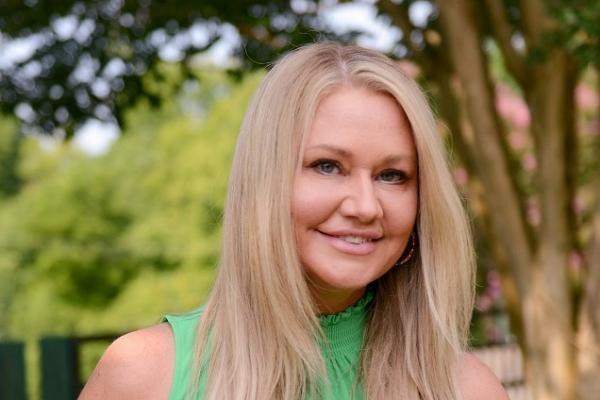
FPG Profile: Sherri Britt Williams
Sherri Britt Williams, MPH, is a senior technical assistance (TA) specialist working within the Trohanis Technical Assistance (TA) Projects at the UNC Frank Porter Graham Child Development Institute (FPG). She serves as a co-PI and associate director for the national ECTA Center, a senior TA specialist with the national STEMIE Center, and co-chair of the International Early Childhood Inclusion Institute. In her work, Britt Williams takes a special interest in family engagement, racial equity, emotional and social development in young children, instructional design for adult learners, leadership and team development, and coaching and consulting for professionals; she has presented on those topics across the U.S. to a variety of audiences.
As part of our FPG profile series, we recently spoke with her to learn more about her work at FPG. Here’s what she had to say.
Tell us a bit about your professional journey—and what brought you to FPG.
I don’t reflect on my professional journey in terms of a sequence of jobs or roles. Instead, I think of my journey as beginning with a worldview shaped by my parents. My mother, Barbara Baxley Britt, was a lifelong educator of children with disabilities and a child advocate, and my father, Rev. J. Vernon Britt, Jr., was a pastor and trusted leader in our rural community. Together, they modeled a kind of servant leadership that deeply influenced how I see my role in the world.
In the early 1970s, following the passage of the Equal Education Opportunities Act of 1973, North Carolina funded a very small number of pilot classrooms across the state to test a new idea—that children with moderate to severe disabilities could be educated in their neighborhood schools rather than in separate settings. My mother was selected to establish one of those very first classrooms in North Carolina. Working in Robeson County, a rural, historically under-resourced part of the state, she helped lead some of the earliest efforts to bring this vision into practice in local elementary schools in North Carolina. At the time, this was a significant departure from how education was structured. These classrooms ended up being proof that something different was possible. The work she and a small number of other educators did during that initial rollout in North Carolina helped demonstrate that children who had often been excluded could learn, participate, and belong in their own community schools. That early pilot work contributed to expanded funding across North Carolina and helped lay the groundwork for what is now standard, and legally required, practice across the country—educating children in inclusive settings whenever possible. What makes that especially meaningful to me is where it happened. My hometown is not a large, well-resourced district. This was a small-town, rural effort to do something different, grounded in understanding and truly caring about people’s needs and doing what was possible to better support children and families in the community.
My father shaped my journey in a different but equally important way by modeling servant leadership. As a pastor, he was known for being humble and deeply present with people, listening without judgment, meeting them where they were, and helping them find a path forward that reflected and strengthened their sense of purpose and faith. He had a quiet way of making people feel seen and understood, even in the most difficult circumstances.
Looking back, I can see how both of those influences have guided my professional journey and show up in my work today. From my mother, I carry a commitment to building systems that open doors and create access. From my father, I carry an approach grounded in listening, understanding, and meeting people where they are. That combination has shaped my professional path and ultimately brought me to FPG, where I have the opportunity to support that kind of work on a broader scale.
What do you do at FPG—describe your job, a typical day, and your current projects.
There’s no such thing as a typical day in my role, and that’s one of the things I value most about the work. Across my roles, my work focuses on strengthening systems, leadership, implementation, and professional learning systems. On any given day, I might be coaching a state leader who is navigating complex systems change, facilitating a team working to co-create new tools or processes, designing professional development supports, or collaborating with colleagues to plan large-scale, nationwide initiatives.
A major focus of my work right now is helping systems think more intentionally about how they design and deliver professional development support. Through the EPIC-P Cycle, a framework I co-developed, I support leaders in moving beyond one-time training toward providing an array of ongoing professional development supports that connect to real and meaningful practice change. I also spend a significant amount of time providing leadership coaching, particularly around adaptive leadership, and supporting teams in strengthening implementation structures so that ideas translate into action. More recently, I’ve been doing a lot of work around authentic co-creation. I’ve been guiding teams through using a couple of other tools I developed, the REAL Framework and accompanying REAL Framework Practice Profile, to support them in moving beyond simply seeking input to meaningfully sharing ownership with families, practitioners, and community partners. Across all of this work, the focus is consistent—helping systems become more responsive to the real experiences of the people they are meant to serve.
What do you like most about your job?
What I value most about my work is the people I get to work with and the range of perspectives I’m surrounded by as we work together to make things happen. Across the ECTA Center and the STEMIE Center, I work with colleagues who are deeply committed to improving systems for young children with disabilities and their families. That commitment doesn’t feel performative. It’s genuine, and it shows up in how people approach the work with care, thoughtfulness, and a willingness to engage with complexity. People bring different backgrounds, experiences, and ways of thinking, and that strengthens the work. It challenges assumptions and helps ensure that what we develop is relevant and useful in a variety of contexts.
At this point in my career, I also value the opportunity to support others. Through leadership coaching and mentoring, I’m able to work alongside leaders, educators, families, and students as they navigate challenges and grow in their roles. That’s work I believe in and genuinely enjoy.
And at the center of it all, I appreciate that my work is focused on making systems more accessible, more responsive, and more supportive for families.
What do you find most challenging?
One of the most challenging aspects of my work is the reality that there is always more to do than there is time to do it. The needs are real and ongoing, and it’s easy to feel pulled in many directions. Over time, I’ve learned that trying to do everything isn’t what makes the work effective. What helps me stay grounded is a simple question I return to often: “What can I do?” Focusing on what is possible with the time, relationships, influence, and resources I have helps me stay intentional and move the work forward in meaningful ways. And then I expand that question: “Who else can be part of this work and bring perspective, capacity, or reach?” This is not work that any one person or team carries alone. When we bring together different perspectives, relationships, and circles of influence, the impact is stronger and more sustainable. That shift, from trying to hold everything to building collective effort to make meaningful impact where we can, is what helps me navigate the challenge.
How does your work further the mission of FPG?
The mission of FPG is centered on improving outcomes for children and families through research, practice, and partnerships. My work contributes by helping ensure that what we know is actually used in meaningful ways. I work with partners across the country to translate ideas into practice. That means helping teams apply frameworks and research in ways that are usable, relevant, and grounded in real-world contexts. Much of my work focuses on bridging the gap between knowledge and implementation and supporting systems in moving from understanding to action in ways that lead to tangible improvements for children and families.
What do you hope to have accomplished five years from now?
I don’t tend to think about five years from now in terms of a specific title or endpoint. I think more about alignment and impact over time. I hope that five years from now, I’m continuing to do work that is meaningful, responsive, and grounded in the needs of the people it is intended to support. I also hope I’ve expanded the reach of the work I care most about—supporting leaders, strengthening implementation, and advancing authentic co-creation with families and communities. More than anything, I focus on how I show up in the work day-to-day, because those daily choices ultimately shape what is possible over time. My work is deeply grounded in my faith, which guides me to approach others with the compassion and meaningful presence I’ve experienced in my own life. I hope that comes through in how I engage with others with care, patience, compassion, and grace, along with a genuine commitment to understanding people’s experiences and supporting them in meaningful ways.
Is there anything else you would like people to know about your work/working at FPG?
One thing I would want people to understand is that this work is ultimately about people, not just programs or systems. It’s about families navigating complex systems, educators and leaders working to do the right thing in challenging contexts, and the relationships that shape those experiences every day. The more we can center those realities and experiences and involve people as true partners in the work, the stronger and more effective our systems become. That perspective shapes how I approach my work at FPG and the broader UNC community.


