


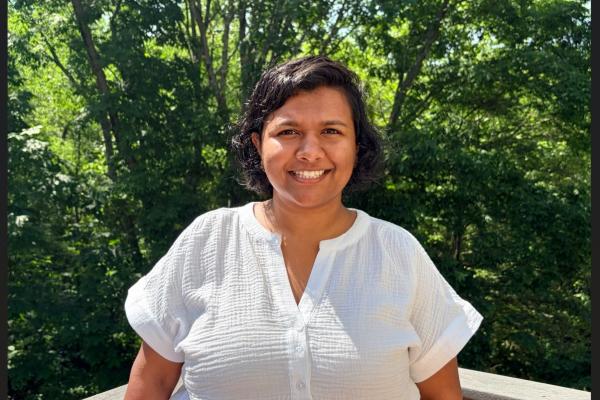
FPG student profile series: Aditi Nambiar
Aditi Nambiar has been working as a graduate student research assistant with Sandra Soliday Hong, PhD, a senior researcher at the UNC Frank Porter Graham Child Development Institute (FPG).
Nambiar recently graduated from the Master of Public Health program at the Gillings School of Global Public Health, with a concentration in maternal, child, and family health. Her academic focus centers on promoting child well-being through violence prevention, mental health supports, and community capacity building.
As part of our FPG student profile series, we recently spoke with her to learn more about how she came to be at FPG and her work here at the Institute. Here’s what she had to say.
Tell us about how you came to be at FPG and about the work you do here.
Coming to work at FPG has been a dream come true for me as I share FPG’s commitment toward transforming the lives of children and families through research and public policy.
I first learned of FPG as an undergraduate student at North Carolina State University (NCSU) because one of FPG’s post-doctoral fellows, Kamilah Legette, collaborated with my advisor, Amy Halberstadt, PhD, at NCSU. That connection introduced me to FPG’s work in improving child outcomes and transforming the health and wellbeing of children.
After graduating from NCSU, I was fortunate to join FPG in August 2022 as a research assistant to support Sandra Soliday Hong’s pre-K evaluation projects.
During my time at FPG, I discovered an interest in Public Health and decided to pursue my master’s in public health. Although I left FPG briefly, I was drawn back to FPG to continue contributing to research that support early childhood programs as a graduate research assistant in 2025. In this role, I provide the team with support across various projects, including participant recruitment for evaluation studies, creating Qualtrics surveys for data collection, scheduling participants for focus groups, and assisting with report writing activities and many other tasks.
What are some key things you've learned working at FPG?
Working with the pre-K project team has helped me develop a wide range of skills and has deepened my understanding of applied research in early childhood education. One of the most valuable lessons has been learning how to evaluate large, statewide, early childhood education programs, including understanding the complexity of implementation, data collection, and analysis across diverse settings.
I have also gained experience in technical report writing, data reporting, and data visualization, skills that have strongly complemented my graduate coursework and strengthened my ability to communicate research findings clearly and effectively.
Another important takeaway has been participating in bidirectional collaborations with state and local research partners. These partnerships have shown me how research can be shaped by real-world needs and, in turn, inform policy-relevant decisions. Through this work, I’ve learned the importance of collaborating closely with state partners to ensure that research findings are translated into actionable policy and practice that can meaningfully support early childhood programs.
What impact has working at FPG with your project team had on your academic and career pursuits?
Working at FPG has had a meaningful impact on both my academic and career pursuits by helping me connect my applied research experience to broader concepts in implementation science and evaluation design. Through my work on these projects, I have gained a deeper understanding of how program goals and intended outcomes are translated into concrete activities, systems, and processes in real-world settings.
My experience at FPG has also complemented my academic coursework by allowing me to put theory into practice. Concepts such as logic models, implementation frameworks, and evaluation designs, often discussed in the classroom, have come to life through my hands-on involvement in evaluation and monitoring activities. Applying these theoretical tools in real program contexts has strengthened my understanding and confidence in using them effectively.
My experience at FPG has also complemented my academic coursework by allowing me to put theory into practice. Concepts such as logic models, implementation frameworks, and evaluation designs, often discussed in the classroom, have come to life through my hands-on involvement in evaluation and monitoring activities. Applying these theoretical tools in real program contexts has strengthened my understanding and confidence in using them effectively.
Overall, this work has significantly deepened my interest in monitoring and evaluation as a career path. Seeing how rigorous evaluation can inform program improvement, policy decisions, and implementation strategies has helped clarify my professional goals and reinforced my commitment to working at the intersection of research, policy, and practice.
Tell us about something you're particularly proud of accomplishing while working at FPG.
One accomplishment I am particularly proud of during my time at FPG is how I have strengthened my technical expertise, especially in managing large-scale data collection systems. When I first joined the team, we were conducting extensive data collection activities across North Carolina and Georgia. One of my key responsibilities was developing and maintaining data collection trackers to monitor project activities and ensure data quality and completion. To do this effectively, I collaborated closely with Jada Walker, Judy Owen, and Cristina Luna-Evans to understand the specific needs of the projects. Working alongside Emily Howe and Esther Chung, I helped design and build a comprehensive data collection tracking system that supported the scale and complexity of our work.
Over the years, I have continued to strengthen my technical skills and have become a go-to resource on the team for building and maintaining trackers. Most recently, I led an Excel tracker training to orient our FPG team on our data collection systems and share best practices for developing trackers tailored to different types of projects. Being able to support both project operations and team capacity-building in this way has been especially rewarding and reflects my growth since joining FPG.
What areas of research are you interested in pursuing in the future?
While my work at FPG has focused on early childhood education evaluation, I have also had opportunities to explore complementary research interests that broaden my perspective and could inform future work. In 2024, when I briefly left FPG to pursue my master’s in public health, I was awarded the HRSA Center of Excellence in Maternal and Child Health Training Grant. Through this opportunity, I worked as a graduate research assistant under the guidance of Meghan Shanahan, PhD, supporting the Essentials for Childhood initiative.
In this role, I contributed to the development of a statewide childhood adversity surveillance system designed to monitor how counties across North Carolina are performing on key indicators of adverse childhood experiences (ACEs) and positive childhood experiences (PCEs). The goal of this work was to support data-driven decision-making by providing actionable information to state and local interest holders. This project was especially meaningful to me as someone who is deeply interested in violence prevention and strategies for promoting child and family well-being, which closely complements FPG’s goals and mission.
My interest in violence prevention, particularly the prevention of child maltreatment, has also led me to have an interest in initiatives at FPG that I have not been involved in, specifically initiatives associated with the National Implementation Research Network (NIRN). I have been especially interested in the Positive Parenting Program (Triple P) and NIRN’s work in state-level capacity building, which aligns with my broader interests in implementation science and capacity building.
Moving forward, I am interested in continuing work that applies research, monitoring and evaluation, and implementation science to strengthen programs and policies that support children and families.
Want to learn how other students are contributing to research, implementation, and impact across the Institute, check out more articles in this series:
FPG student profile series: Menna Mburi
FPG student profile series: TK Musa
FPG student profile series: Susie Welty


