


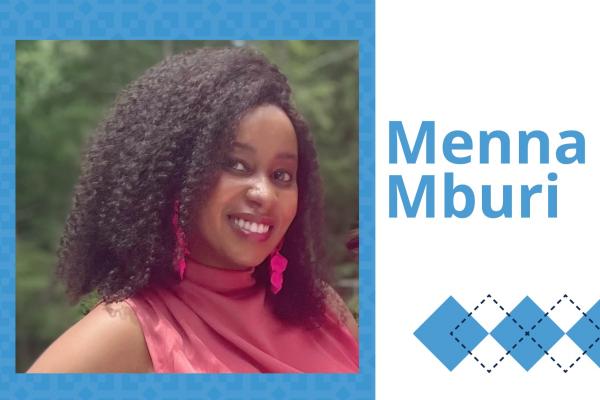
FPG student profile series: Menna Mburi
Menna Mburi is a PhD candidate in public policy at UNC-Chapel Hill whose work focuses on the well-being of Black children and families across the Diaspora, with an emphasis on immigrant populations. As the daughter of Tanzanian immigrants and someone who grew up in a mixed-status household, she brings a personal and scholarly commitment to examining how public policies and practices impact Black immigrant communities, particularly in relation to poverty, early care and education, and maternal and child health. Her dissertation examines how state decisions to expand Medicaid and CHIP eligibility for immigrants historically excluded from public health coverage shape maternal health care access and related outcomes among Black immigrant mothers and infants. After graduation, she hopes to continue collaborating with communities, families, researchers, policymakers, and practitioners to help advance policies that support the well-being, dignity, and flourishing of children and families.
Prior to pursuing her PhD, Mburi was a data analyst at Duke University’s Social Science Research Institute where she supported interdisciplinary projects focused on child development and STEM education. As a graduate research assistant with the Equity Research Action Coalition (ERAC) at the UNC Frank Porter Graham Child Development Institute (FPG), she continues to work collaboratively with researchers, including ERAC's Founding Director, Iheoma Iruka, PhD, and community leaders to advance racial equity in early childhood. Mburi holds a master’s degree in education policy and management from the Harvard Graduate School of Education and a bachelor’s degree in political science from UNC.
As part of our FPG student profile series, we recently spoke with her to learn more about how she came to be at FPG and her work here at the Institute. Here’s what she had to say.
Tell us how you came to work at FPG and about the work you do here.
I came to work at FPG after entering UNC’s doctoral program in Public Policy in 2021. Before starting my doctoral program, I worked at Duke University’s Social Science Research Institute on child development and education research and taught in classrooms in the U.S. and abroad. Those experiences reaffirmed something I already knew about myself: I wanted to do research that could contribute meaningfully to the lives of children, families, and communities, particularly those directly impacted by racism and poverty.
When I entered the program, I shared that goal with my advisor and mentor, Iheoma Iruka. She enthusiastically welcomed me into collaborative research opportunities at FPG with the Equity Research Action Coalition, where I have been able to continue developing as a researcher while working on projects aligned with my interests and values. Since joining ERAC, I have contributed to projects focused on advancing racial equity for children, families, and communities from socioeconomically disadvantaged backgrounds. My work with the team has included evaluating programs that support coaching models for teachers and providers working in under-resourced center- and home-based child care programs, as well as partnering with early childhood professionals to develop goals and strategic plans for addressing systemic racial disparities in hiring, pay, and professional opportunities in Western North Carolina.
More recently, my research has focused on maternal and infant health, particularly the experiences of Black immigrant mothers within the U.S. maternal health care system. This area has become the focus of my dissertation and reflects my passion for understanding how policy, systems, and lived experiences shape health and well-being for diverse Black families and children. Through community-rooted partnerships, I am learning directly from advocates and mothers about the barriers they face in accessing health care and the changes they believe are needed to help Black immigrant mothers move from surviving to thriving during pregnancy and motherhood.
Can you share some key takeaways of things you’ve learned working with your project team?
One of the most important lessons I have learned is the value of starting with communities. The most meaningful and impactful change happens when the people most affected by an issue help define the problem and shape the response. Researchers often enter partnerships with questions they already want to answer. In many ways, this is by design. While that approach can produce valuable knowledge, I’ve learned that the strongest partnerships emerge when researchers are transparent about how their identities and life experiences shape their work, and when they come together with community members from the very start of a project to decide which questions matter most and the best ways to answer them. This kind of collaboration helps ensure that the research isn’t only rigorous, but also captures the stories and counterstories of individuals and communities in ways that honor their histories and experiences, preserve their dignity, and generate knowledge that is relevant and useful.
What impact has working at FPG with your project team had on your academic and career pursuits?
Working at FPG with Dr. Iruka and ERAC has helped shape my identity as a scholar and clarified the kind of researcher I want to be. My earlier training placed a strong emphasis on quantitative methods, though my thinking about data and rigor has long been shaped by prior coursework in ethnic studies at the Harvard Graduate School of Education, which encouraged critical engagement with numbers and the systems that produce them. At FPG, I have been able to build on that foundation, including through my own dissertation, by integrating approaches that center voices, narratives, and critical frameworks alongside quantitative analysis.
My time at FPG has also helped me better understand the kinds of environments where I thrive—places where community-engaged and social justice-focused research is valued and supported, and where I can see myself reflected in the people around me.
Looking ahead, I dream of a career that connects research, community advocacy, policy, and practice in meaningful ways. I believe that research can be used to advance racial equity and social justice, despite the ways it has historically been used as a weapon of oppression. I want to continue learning and working with others to make this tool accessible and useful to people who have historically been excluded from the decision-making table because of their race, ethnicity, gender, immigration status, and income, among other factors.
Can you tell us about something you’re particularly proud of accomplishing while working with FPG and your project team?
One of the accomplishments I feel most grateful for and humbled by is receiving my first research grant alongside Dr. Iruka through the Robert Wood Johnson Foundation’s Policies for Action (P4A) program, which is administered through the Urban Institute. The grant supports research on policies that can strengthen the social, economic, and civic inclusion of immigrant children and families and help create meaningful systemic change. I am especially grateful to Dr. Iruka for sharing this opportunity with me and trusting me to help lead this research, particularly because it is connected to my dissertation. As co-principal investigator, I have gained valuable experience writing my first grant, learning how to communicate research clearly, and thinking more intentionally about how to make findings accessible and useful beyond academia.
This opportunity has also connected me with an inspiring community of grantees across the country. Through these spaces, I am learning from people working to address issues that affect the health and well-being of communities, including housing, policing, land justice, and community wealth building. I am continually inspired by the commitment, vision, and care they bring to their work.
This grant is also deeply personal to me because it acknowledges that Black immigrant communities have important stories and knowledge to contribute to our understanding of maternal and infant health, immigration, and beyond. It also gives me the opportunity to help bring more attention to the lived experiences of low-income Black immigrants and the challenges they face in navigating systems shaped by racism, anti-immigrant discrimination, and other forms of exclusion. Just as importantly, it allows me to highlight the strengths and resilience that help Black immigrant mothers navigate these barriers, support one another, and flourish during pregnancy and motherhood.
When are you finishing your program and what are your plans following that?
I am currently in the final stretch of my doctoral program in Public Policy and am looking forward to graduating in May 2027. One question that drives my research focus is: How can we better support the health, well-being, and development of diverse Black immigrant children and families who represent a growing share of the nation’s Black population, but are often overlooked or excluded from research and policy conversations?
My plan is to develop a mixed-methods research agenda focused on examining this question after graduation. I would love to pursue collaborations focused on evaluating the impact of existing policies and re-imagining and designing more equitable and just policies. I will be entering the job market this fall and am excited for what comes next!
Want to learn how other students are contributing to research, implementation, and impact across the Institute, check out the other stories in this series:


