


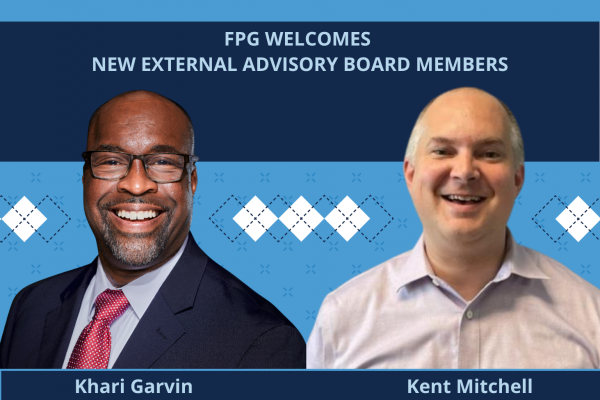
FPG welcomes two national leaders to its External Advisory Board
The UNC Frank Porter Graham Child Development Institute (FPG) has welcomed Khari Garvin, MEd, and Kent Mitchell, MPP, to its External Advisory Board, a group of leaders who provide expertise and counsel to help advance the Institute’s work. Garvin and Mitchell bring extensive experience in early childhood education, public policy, human services, research translation, and systems change—perspectives that will strengthen FPG’s efforts to improve outcomes for children and families.
Working in a consultative capacity, the board supports FPG’s strategic initiatives, state engagement, and community connections. Its guidance is especially valuable as FPG advances priorities including language and literacy in early development; innovative technology and data science in education; the cultural resilience and wealth of marginalized and minoritized communities; and a life course perspective on developmental disability and mental health. In the following Q&A, Garvin and Mitchell share what drew them to FPG, the issues that matter most to them, and what they hope to contribute through their board service.
Meet Khari Garvin
Khari Garvin, MEd, brings more than 20 years of senior executive leadership in early childhood education, human services, and public policy to his role on FPG’s External Advisory Board. His career spans government and nonprofit organizations, with a sustained focus on strengthening systems and expanding opportunities for young children and families.
Appointed by President Biden to lead the Office of Head Start within the U.S. Department of Health and Human Services’ Administration for Children and Families, Garvin set the strategic direction for the federal program serving children from birth to age 5 and their families across all 50 states, Tribal lands, and U.S. territories. During his tenure, Head Start underwent significant regulatory reforms designed to strengthen the program and better support children, families, and the early childhood workforce.
Before entering federal service, Garvin served as president and CEO of United Way of Greater Greensboro, where he led a communitywide initiative to break the cycle of generational poverty by aligning the efforts and resources of nonprofits, businesses, and government agencies. He has also served at every level of Head Start programming, including as director of the North Carolina Head Start State Collaboration Office and in grantee-level roles supporting urban and rural communities across the Southern, Southeastern, Midwestern, and Great Plains regions of the United States.
What drew you to FPG and its mission?
I was drawn to FPG because of its recognition of the value of the education and development of children in the early years and the critical importance of that work to be informed and shaped by research and science.
What aspects of FPG’s work are most meaningful or compelling to you?
FPG fills a unique role as a trusted, non-partisan resource of research, policy, and practice in the child development space. The steady presence and reliable voice FPG provides in a world of vastly shifting ideologies and the ebbing and flowing of public will to support early care and education becomes increasingly compelling to sustain an unwavering commitment to young children and families.
What are you most looking forward to contributing to or learning through your board service?
I hope to support FPG’s goals to deliver on its mission and strategic ambitions by contributing a perspective derived from a set of career experiences forged at the intersection of direct services and policy development in early childhood education.
Is there a particular issue facing young children and families today that you feel especially passionate about?
I think one of the greatest challenges young children and families face today continues to be a lack of full access to high-quality care. Despite what over a half century of research has revealed in terms of the benefits of high-quality early childhood education services to children, families, and communities, we continue to face the headwinds of making those services universally available to all.
Meet Kent Mitchell
Kent Mitchell brings more than 25 years of experience advancing policies and practices that improve outcomes for children, youth, and families to his role on FPG’s External Advisory Board. As director of policy for the Society for Research in Child Development (SRCD), a membership organization of 3,000 researchers, practitioners, and policymakers, he leads efforts to help members engage in public policy, translate research for decision-makers, advocate for federal research funding, and advance positive systems change.
Mitchell’s career spans government, philanthropy, and the nonprofit sector. Most recently, as vice president of strategy and innovation for Lutheran Services in America, he led national collaboratives focused on child welfare, affordable housing, and refugee resettlement. His earlier roles include directing 50-state government affairs for the National Head Start Association, stewarding a successful grassroots pre-K campaign in Indiana, launching bipartisan children’s policy initiatives at the Pew Charitable Trusts, serving with AmeriCorps, and advancing disability policy for U.S. Senator Edward M. Kennedy. At SRCD, he also helps sustain the organization’s U.S. Policy Fellowship, which places early-career developmental scientists in federal and state government.
Drawing on his training as an organizer, Mitchell specializes in analyzing systems, designing inclusive strategies, engaging people with lived experience, and building cross-sector partnerships. He has served on two nonprofit executive teams and helped cultivate more than $50 million in philanthropic funding. Mitchell holds a Master in Public Policy from the Harvard Kennedy School, with a concentration in nonprofit management, and earned his bachelor’s degree in political science and journalism from Earlham College.
What drew you to FPG and its mission?
Across a 25-year career in federal and state policy and social innovation, I have been an avid consumer of FPG’s expertise. Whether it was research on how to better support children with disabilities or guidance from Dr. Iheoma Iruka on how to consider and advance equity, FPG has been an invaluable resource in developing public policies that measurably improve children’s lives. I am honored to be joining an interdisciplinary center with such a bold commitment to research-policy application.
What are you most looking forward to contributing to or learning through your board service?
The landscape for public policy and scientific research is changing so rapidly. Trust in key civic institutions and science is low. In this landscape, I believe it is essential to figure out how FPG can be an even more credible and powerful voice for children. I am interested in how we collectively assess and navigate this landscape, together, through the relationships, strengths, and commitments that unite us.
Is there a particular issue facing young children and families today that you feel especially passionate about?
I remain deeply concerned about the impact of inequality in our society on children and families. Access to high-quality education, health care, stable housing, and so many other needs fundamental to child development is lacking for millions of children in the U.S. The scale of the challenge is being compounded by concerted efforts to link access to care to citizenship. All children, regardless of their or their parents’ immigration status, deserve safety, enrichment and opportunity in early childhood and beyond.
What would you want FPG faculty, staff, partners, and supporters to know about you as you begin this role?
My childhood was spent abroad. My father was a U.S. diplomat, and I grew up in Togo, Canada, Greece, Belgium, and South Korea. It was in these contexts that I saw the multitude of ways in which cultures and societies feed, play with, house, educate, and care for children. In important formative years, I benefited greatly from how family is revered in Greek culture. As a teenager, the safety of Seoul allowed me to roam and explore independently. As a pluralistic society, we have so much to learn from embracing, experiencing, studying, and bridging the diverse contexts in which children develop.


