


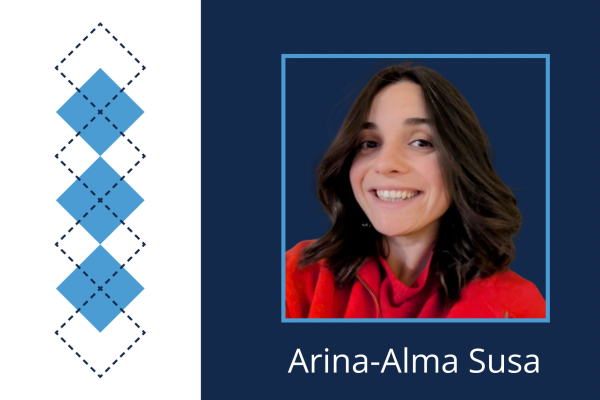
International doctoral graduate student joins NIRN for Spring program
The UNC Frank Porter Graham Child Development Institute (FPG) advances the well-being of children and families through interdisciplinary research, evaluation, implementation, technical assistance, and outreach at local, national, and international levels. We collaborate with partners worldwide and actively promote opportunities for colleagues to engage with our work in Chapel Hill.
In partnership with the LaRAC Institute at the University of Grenoble Alpes in France, we are pleased to welcome Arina-Alma Susa to FPG, a doctoral student, who will be working with FPG’s National Implementation Research Network (NIRN) under the supervision of Ximena Franco-Jenkins, PhD. We recently spoke with Arina to learn more about her work and her journey to Chapel Hill and here’s what she had to say.
Could you tell us about yourself and your academic journey?
Oh my, this has been an interesting ride! I have a pretty surprising academic journey. After I graduated from the political sciences institute of the University of Grenoble Alpes, I pursued my studies with an agronomy specialization. I got accepted in a very unique program in France (AgroParisTech) and did my internship in the Netherlands (Wageningen University). My focus was building resilient community-based food systems, adapted to global changes. Small-scale family farming is what feeds us on a planetary level. That’s why I’ve dedicated all my energy in my early professional career to working for nonprofit organizations or research projects in Latin America and Europe. I was working to connect science and practice creating socially and technically sustainable initiatives in agriculture. I would coordinate projects to help empower farmers in developing, growing, and spreading grassroots innovations.
I worked with a great variety of people with brilliant minds, hearts, and hands. But when it came to disseminating these practices from one farm to another, hoping these would persist in time—it became a great challenge that I was poorly equipped to face. Within my organization, the systemic change and policy shifts we were aiming for always felt out of reach. We would put in a lot of effort in terms of community organizing, for creating quality knowledge brokering services, in terms of capacity building for swarming efforts and we would provide this data-driven support and information to influence decision-making at multi-layered policy levels. But with the rapid turnovers and constant leadership changes, we simply weren’t producing the impacts we were hoping for.
That’s when I realized that if I wanted to be a stronger advocate for social transformation in any system, I had to understand implementation barriers and levers better. So, I’ve decided to take a step back and start a PhD focused on implementation. Besides, there had always been a side of me that wanted to work in education and with children. I figured it was the right moment to root this new scientific experience in a field that was completely new to me. That’s how I became a doctoral student in learning sciences, at the University of Grenoble Alpes, working on implementing evidence-based practices in education.
I’m part of a marvelous and inspiring team, in a training and research hub called Pégase. We mentor education professionals to discover and adopt efficient evidence-based practices. We’re trying to assess the impact of some tools that my research institute, the LaRAC, along with other institutes have co-designed with practitioners. Our multi-tiered approach for improving learning in early childhood is focused on explicit instruction of literacy and numeracy. Almost 100 teachers of a French academic district were trained in the past two years. The assessment is done through a quasi-experimental longitudinal study following cohorts of students over two years to evaluate outcomes. It’s lead by my two fantastic supervisors: Dr. Anna Potocki and Dr. Laurent Lima.
Our goal in Pégase goes beyond just training and evaluating this “innovative” approach in the public French education system. We seek to co-build professional development of teachers, to help them adopt effective evidence-based practices and pedagogies and to reduce inequalities amongst students on a large-scale. At the moment, we’re still building readiness amongst teachers, curriculum advisors, and researchers before the longitudinal study starts. It’s a challenging and stimulating transdisciplinary set-up where we are all working together to evaluate the efficacy and efficiency of our disseminated practices. All of this is aimed to create better learning settings for children so we feel very strongly about the teacher and researcher partnerships that we are co-creating. Being close to the Alps is challenging too, some schools are in very urbanized settings, and others are in very secluded villages in the mountains. Context variability is huge. So having a strong plan to reduce inequalities in this complex academic district is essential. This pilot program will help us build a strong foundation to create tailored implementation support structures that meet the specific needs of teachers, schools, and communities, while enabling sustainable impact and intervention adoption.
This fall we’ll start evaluating students’ responses to teaching interventions. It’s a 3,000-students cohort, aged between 4 and 6 years old. We’ll be testing interventions that have both to do with literacy and numeracy skills. If this pilot goes well, we will be able to disseminate results and work toward scaling-up efforts in the academic district—and my PhD will provide a roadmap to do so. I hope all the knowledge and expertise on implementation I’m acquiring will serve many other topics and human services in the future.
How is it that you’ve come to work with NIRN?
As I was doing my literature review, exploring different implementation frameworks, the work of the National Implementation Research Network inspired me straight away.
A couple of weeks into my first year, I heard about an opportunity to apply to a university-based scholarship for an exchange student program called IDEX. That’s when I thought, I should go to learn more about NIRN! And I was lucky to speak with Dr. Ximena Franco-Jenkins, the co-director. I reached out on LinkedIn, and she was extremely supportive and managed to make some time for a Zoom call. After a brief meeting where I shared my goals, she presented to me different NIRN projects. I remember being amazed about the robustness and quality of NIRN’s research—and later, by the beauty and warmth of their interactions as a team in their dissemination presentations of the Effective Implementation Cohort (EIC). We stayed in touch, Dr. Franco-Jenkins wrote me an invitation letter for my scholarship application, and here I am now ready to conduct my exchange program at FPG. I want to thank the NIRN co-director and Erica Nouri, as they’ve both helped me so much with the administrative process.
I think exchange programs have the potential for fostering meaningful scientific impact. Back in France, implementation is something new. Exchange programs like these help highlight the value of social sciences in a rapidly changing world, providing adaptative frameworks for a better understanding of what is common or specific to implementation dynamics in different cultural contexts, which is essential in the current context. Because here, in the U.S., and especially in North Carolina, universities like Carolina have been conducting excellent research on implementation for decades now, and that’s truly inspiring to me. There’s just so much to unpack and discuss. It might not be a science yet, but it’s definitely fascinating to study, at the intersection of emerging practice and scientific inquiry. We’re basically shaping a new discipline as we're studying it rigorously on different sides of the world. Thus, aligning our visions and missions as scientists through cross-cultural exchanges seems to be a relevant way of strengthening epistemic communities for paradigm shifts to happen. But to me, spending quality time here at FPG is also about solidarity amongst researchers that are working toward social transformations. There is just so much passion.
What will you be working on at UNC?
I will take part in team meetings and seminars related to the EIC and State Implementation and Scaling up of Evidence-based Practice (SISEP). I hope to engage deeply with NIRN’s team and participate in FPG’s research ecosystem. More broadly, during my stay, I hope to explore opportunities for scientific collaboration and implementation in cross-cultural contexts, in order to collectively progress in the research scope of scaling-up educational innovations that work. I like to think about evidence-based approaches as a science, practice, and movement—where implementation would be the practice side of it. I also believe that implementation offers us a powerful lens to reveal what interventions are (or aren’t) doable, learnable, and scalable—because sometimes “what works might hurt” and de-implementation is key to ensure better learning climates both for students, but also teachers. By being able to engage with both PI’s of SISEP (Dr. Mel Livet) and EIC (Dr. Ximena Franco-Jenkins), I’m sure a lot of creative and impactful ideas will come out of our discussions and meetings to create bridges between our practices and research methods. Essentially, I’m hoping to transpose some of my learnings from NIRN projects and adapt some open-source tools to my context back in France (according to professional standards, cultural factors, structural organization differences…).
Where do you see yourself five years from now? What do you hope to be working on?
Where do I see myself in 2031? On an individual level, I hope to be a doctor in learning science and have defended my doctoral thesis by then. After my 10-year agroecology era, I would love to further explore education topics—especially models of cultural pedagogy in early childhood education and build projects focused on multi-tiered support systems designed to help children with multicultural backgrounds. I’m sure someday my two interests will connect. There’s a lot to explore in environmental education too. For instance, launching longitudinal studies and implementation research in this field as well could be promising. But considering my background, I truly feel a calling to work with decision makers—really tapping into those findings about barriers and levers that we can work around to make policy shifts happen. My dream would be having one foot in a think-tank and another one in a research institute, kind of like a “boundary-spanning” role with a dual affiliation, always connecting science and practice.
On a more collective level, I also dream that my research findings and recommendations will turn into policy-briefs that could open a path for future research-action-training initiatives on creating implementation teams and to develop certifications and competencies for practitioners to become implementation specialists in France. We started an implementation group in my institute, at the initiative of Dr. Celine Pobel Burtin, who recently defended her doctoral thesis on implementation. If this becomes a NIRN-like French network with an active implementation hub and a couple of state-funded projects, I would be thrilled.
Is there anything else you would like people to know about you and your academic work?
As I said, a big part of my work focuses on testing the key approaches and tools developed by the U.S. network adapted to the French context. The results of these capacity-building efforts will be qualitatively analyzed, looking at the acceptability, adoption, and appropriation of the active implementation frameworks in different contexts. Since we trained more than 100 teachers and curriculum advisors, there will be a pioneer pool of practitioners that I’m hoping to make a team with. Because practice-wise, we’re building a whole implementation arm from scratch in Pégase, I think that’s going to be an interesting case to empirically study.
The data that we will collect will help us to both monitor and model the impact of the teachers’ fidelity of intervention on the students’ performance according to their context but also according to the professional development of the teachers and their receptivity to the evidence-based practices we’ve transferred. Research-wise, we’re trying to inform strategies for scaling-up interventions across contexts based on this nested and longitudinal data collected at multiple measurement points. There sure are some statistical and methodological challenges there that I’m eager to work on!
Finally, I will conduct a qualitative and comparative study of the mechanisms that have supported the implementation and/or scaling up of evidence-based initiatives in education in different settings, either at district or state levels. That’s why I came all the way to the U.S.—to understand better the roots and fruits of implementation in cross-cultural contexts through process-tracing approaches. I’m seeking to capture mechanisms, not just correlations, between implementation drivers, fidelity, and intervention adoption. I want to know why certain projects succeed (or fail) to create champions and professional communities able to generate system-level change and policy shifts. If this speaks to you, I warmly welcome international collaborations! My e-mail address is arina.susa@univ-grenoble-alpes.fr.


