From Kyoto to Carolina: mimamoru and high-quality inclusion in early childhood
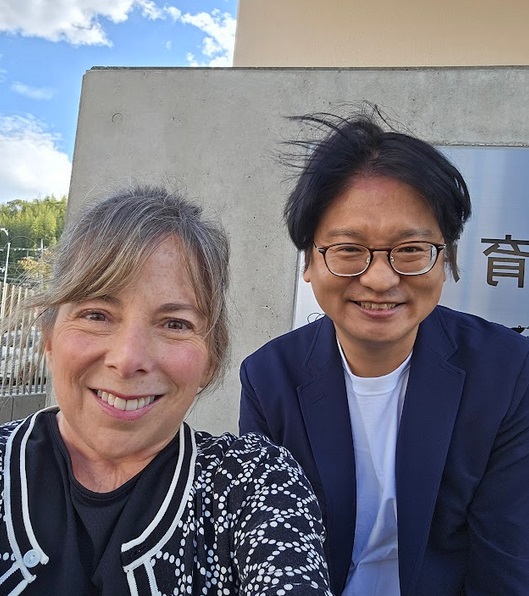
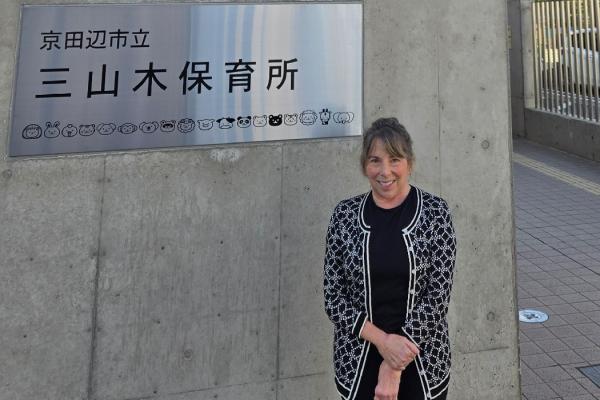
How does the learning environment foster a sense of belonging for every child? How does a teacher’s silence empower a child’s voice? These questions guided a recent site study in Japan, where Jani Kozlowski, MA, a technical assistance specialist at the UNC Frank Porter Graham Child Development Institute (FPG), partnered with Ryutaro Shintani, PhD, an assistant professor in the Department of Childhood Studies at Doshisha Women’s College of Liberal Arts in Kyoto, to observe inclusive practices across early childhood centers in Kyoto and Osaka.
Kozlowski’s work was supported the Richard M. Clifford Fund for International Collaboration on Early Learning Environments. The fund, which was established by now retired FPG senior scientist Dick Clifford, is meant to preserve and expand FPG's efforts to assess learning environments for young children everywhere, focusing on international collaborations among researchers and colleagues, universities, and government and non-government agencies abroad. Clifford, who fully retired from FPG in 2012, still actively works to ensure that all children have safe, equitable, empowering learning environments where they can learn to think and dream bigger, just as he always has.
Using the Indicators of High-Quality Inclusion—with a focus on Environment (E1), Child Autonomy (E2), and Peer Relationships (E5)—Kozlowski and Shintani explored how Japanese principles can enhance our understanding of high-quality, inclusive care in the United States.
The convergence of pedagogy
Kozlowski, who is a national expert in early childhood inclusion, shared that one of the most notable discoveries occurred at a center where the program director had been deeply influenced by Richard Clifford’s work.
The director of Takatsuki Futaba Kindergarten described using Clifford’s assessment tools to prompt educators to reflect on their teaching practices and learning environments, demonstrating that a shared language of quality can transcend borders. Use of the tools inspired many key changes, including:
- Representation in play by introducing baby dolls with a range of skin tones to reflect a more diverse global community.
- Inquiry-based science by using everyday play to teach complex concepts, such as inviting children to notice and describe the different textures of playground surfaces—from the coolness of pavement to the crunch of gravel and the softness of grass.
Indicator E1: The inclusive physical environment
“In Japan, the environment is often described as the “third teacher,” said Kozlowski. “Inclusion is not treated as an add-on; it is embedded in the architecture of the day.”
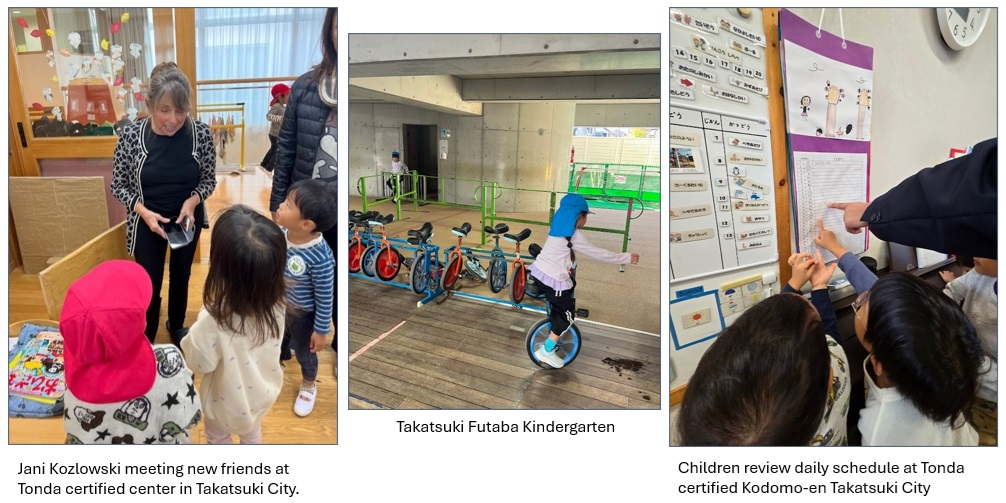
To support children who benefit from predictability, centers use beautifully illustrated, hand-drawn, daily schedules. These inclusive supports help children navigate transitions independently, lowering anxiety and building a sense of mastery over their day.
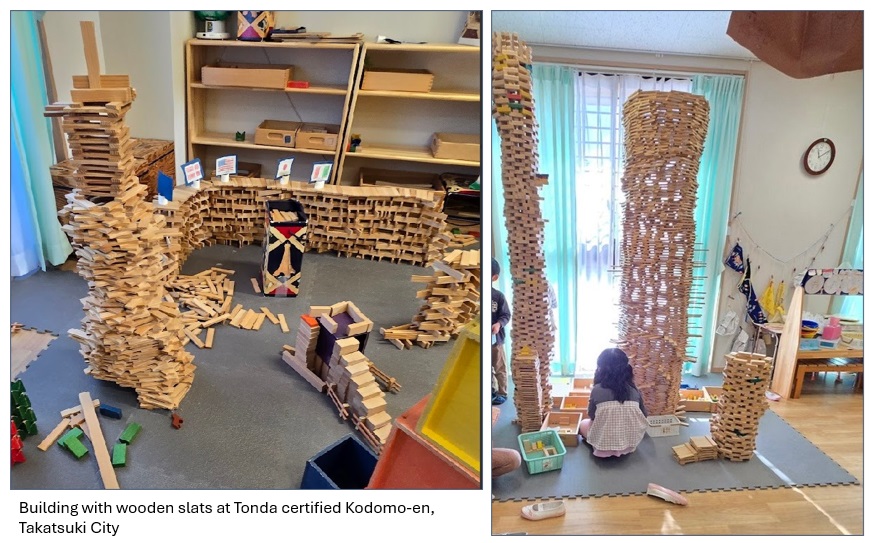
Furthermore, materials such as unicycles, pogo sticks, and wood-slat construction sets invite children to test their limits in developmentally appropriate ways. These experiences teach anzen (safety) through the lived experience of kiken (danger), helping children of all abilities better understand their physical agency. As one program director explained to Kozlowski, children encounter large and small dangers every day, and it is impossible to eliminate them all; without experience, they cannot develop the ability to sense and respond to risk.
Indicator E2: The principle of mimamoru (autonomy)
Kozlowski saw that the Japanese concept of mimamoru, “watching and waiting,” is a powerful practice for promoting autonomy (Indicator E2).
“Instead of stepping in immediately during a struggle,” said Kozlowski, “teachers ‘protect with their eyes,’ allowing children the dignity of working through challenges and solving problems on their own.”
Whether building intricate block towers or harvesting vegetables in the school garden, Kozlowski saw that children are given time to fail, revise, and ultimately succeed without premature adult intervention. This patient stance communicates trust in children’s competence and supports the development of persistence and problem-solving.
Indicator E5: Fostering meaningful peer relationships
According to Kozlowski, some of the most moving observations were connected to Indicator E5: Peer Relationships. In Japanese centers, a whole-child approach emphasizes children’s responsibility to and for one another. Literacy provides an opportunity for connection as peer-to-peer reading is common. Older or more fluent children often sit with classmates to share stories, transforming a cognitive task into a social and emotional bonding experience.
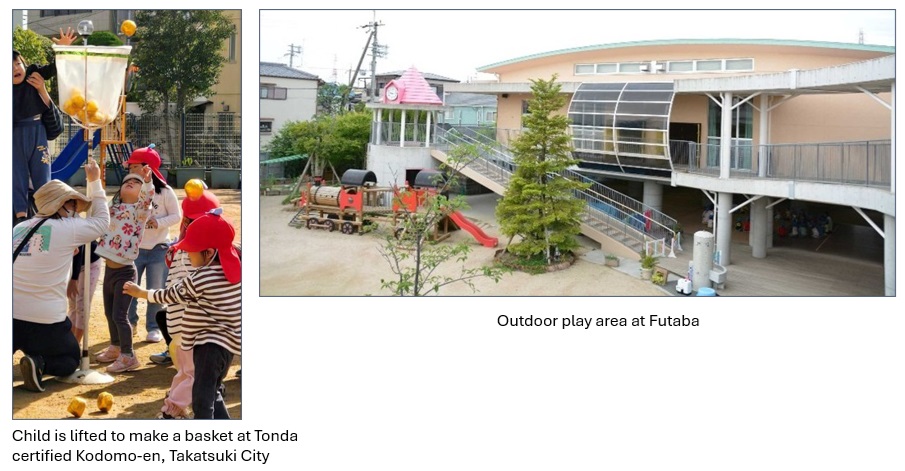
Kozlowski was impressed by the inclusive engagement she witnessed, where teachers act as subtle facilitators rather than directors. Kozlowski shared that in one observation, a teacher provided just enough support for a child with a disability to participate fully in a high-energy outdoor game, ensuring the child was a central participant rather than a bystander.
Building a global bridge for inclusion
Kozlowski believes this partnership has done more than document differences in practice, indicating that it has begun to build a bridge for future early childhood leaders. “By observing how Japanese practitioners promote autonomy, purposeful risk-taking, and meaningful peer interactions,” says Kozlowski, “we can deepen implementation of the Inclusion Indicators in early learning settings in the U.S.”
As this U.S.–Japan network grows, Kozlowski believes lessons from classrooms in Kyoto and Osaka will continue to inform how we can design environments where every child—regardless of ability or background—is seen, trusted, and included.
Kozlowski will provide more information about the Japanese early childhood site study in an upcoming blog series in her Every Child Can Fly Newsletter.
Photos from the site visit
In the three photos below, from left to right: Jani Kozlowski meets children at Tonda certified center in Takatsuki City; a young child rides a unicycle beside a collection of unicycles at Takatsuki Futaba Kindergarten; three young children review a daily, wall-mounted schedule at Tonda certified Kodomo-en Takatsuki City.
In the two photos below, from left to right: a classroom at Tonda Certified Kodomo-en in Takatsuki City with wooden building blocks and slats in various states of towers, walls, and stacks; another similar classroom with a young student sitting in front of three stacked towers of wooden building blocks and slats.
In the two photos below, from left to right: children play on a playground at Tonda Certified Kodomo-en in Takatsuki City with teachers nearby, one child is being lifted to toss a ball into a basket; Outside view of Takatsuki Futaba Kindergarten's outdoor play area.