


Turning inquiry into insight, McKinney Scholars close summer with research and reflection
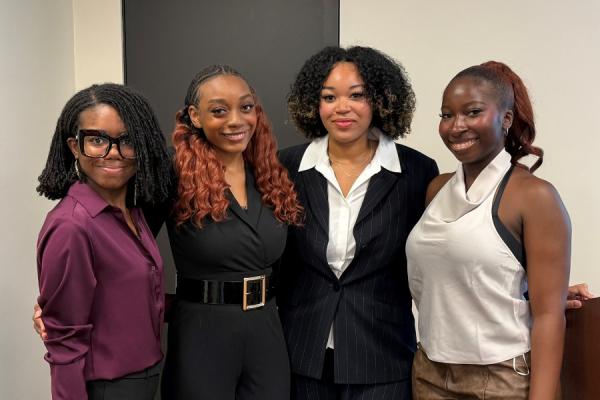
After nine weeks of hands-on learning, the 2026 Marvin H. McKinney Scholars (pictured above from left to right: Anastasia Sellars-Thompson, Karima Mitchell-Hill, Amanda Lee, and Mariah Hackett) closed their summer experience at the UNC Frank Porter Graham Child Development Institute (FPG) by sharing projects that reflected both scholarly inquiry and deeply personal commitments to improving outcomes for children, families, and communities.
During the culminating presentation, scholars described how the McKinney Scholars Program helped them strengthen research skills, explore career pathways, and better understand how research, practice, policy, implementation, and technical assistance intersect to support young children and their families. Throughout the summer, they worked with mentor teams, participated in research rotations, attended several workshops, summits, and retreats.
“Today's presentations will highlight, not only their research, but their personal and professional growth that they went through over these last nine weeks,” said Sherra Lawrence, MA, lead of the McKinney Scholars Program, as she welcomed attendees in person and online. “Each of the scholars will share a little bit about their journey, a little bit about themselves, and the projects that they explored, and reflect on what they learned.”
Exploring access, equity, and belonging
Amanda Lee, a rising senior at North Carolina A&T State University studying psychology through the Honors College with a minor in child development and family studies, examined why youth who could benefit most from after-school programs are not always able to participate consistently. Lee pointed out that, currently, data indicates that children from higher-income families participate in after-school programs at a rate of about 21%, compared to only 9% of children from low-income families. Her systematic literature review identified two major themes behind that gap: structural barriers such as cost, transportation, safety, location, and scheduling, and the importance of program fit once young people arrive.
Lee said the topic was personal, explaining that she had seen after-school programs provide a safe and supportive space for young people in her own family. Her research emphasized that access alone is not enough: Programs also need to feel relevant, relational, age-appropriate, and meaningful if youth are going to keep coming back.
“Simply creating the program does not guarantee that the youth that it was intended for will actually be able to participate,” Lee said. “And, getting the youth through the door is simply not enough. The program must also feel relevant and supportive to the child and also be worth them returning.”
Asking better questions about diagnosis and support
Mariah Hackett, a rising senior psychology major at North Carolina Central University, focused her project on why Black children are diagnosed with autism later than children from other racial groups. Through a systematic literature review of peer-reviewed resources from 2015 to 2026, Hackett explored themes related to healthcare access, provider bias, delayed diagnosis, and the consequences for early intervention.
Hackett said delayed diagnosis can postpone services that support communication, behavior, school readiness, and social development. Her work also pointed to the need for more culturally responsive diagnostic practices and greater representation of Black children—especially Black girls—in autism research.
“If you don’t have the data to connect to your research, it’s really just thoughts,” Hackett said, reflecting on the importance of diverse, high-quality evidence.
Hacket also reflected on how important the mentorship provided during the McKinney Scholars Program has been saying, “Overall, each mentor rotation has taught me the importance of strengthening my communication, teamwork, and attention to detail, while also helping me understand what it truly takes to turn research into meaningful work.”
Examining policy, discipline, and the school-to-prison pipeline
Karima Mitchell-Hill, a rising senior psychology major at North Carolina Central University and first-generation college student, studied how policies influence suspension, expulsion, and juvenile justice involvement among Black students. Drawing from a systematic literature review using peer-reviewed articles from 2010 to 2025, Mitchell-Hill explored restorative justice policy, disciplinary disparities, and the broad reach of the school-to-prison pipeline.
Mitchell-Hill said the project grew from experiences she witnessed growing up in Brooklyn, where she saw how punitive school policies can make students feel more like statistics than children deserving of support. Her summer at FPG helped her understand that research is rarely simple or linear. “Research is not black and white,” she said. “It has a gray lining.”
Connecting lived experience, child welfare, and policy change
Anastasia Sellars-Thompson, a senior social work major at Fayetteville State University and McNair Scholar, centered her research on financial disparities between grandmother caregivers in kinship care and licensed foster parents. Drawing from peer-reviewed research and policy reports, she examined how child welfare policies contribute to differences in financial assistance and supportive services.
Sellars-Thompson, who shared that she was raised in kinship care by her grandmother, said her lived experience inspired her commitment to child welfare research. Her findings highlighted how caregivers can provide the same essential care as licensed foster parents while receiving fewer resources—and how financial strain can affect both caregivers and children.
“A large part of research involves organizing data, analyzing it carefully, and making sure the evidence tells a meaningful story,” Sellars-Thompson said.
Mentorship that links research to real-world impact
Over the summer, scholars rotated through FPG projects and groups, gaining exposure to implementation science, technical assistance, data management, pre-K evaluation, child welfare, early childhood systems, and policy-focused work. They described learning how evidence is gathered, translated, implemented, and used to strengthen programs and systems.
Several scholars noted that the experience broadened their understanding of possible career paths. Lee plans to pursue graduate study in clinical psychology or clinical social work with a developmental focus. Hackett plans to pursue a master’s degree in clinical psychology and eventually open a private practice for children and families. Mitchell-Hill is considering social work, public health, or a dual-degree pathway after graduation. And Sellars-Thompson plans to pursue a master’s degree in social work and continue advocating for equitable child welfare policies.
For Lawrence, the culminating presentations offered a chance to recognize not only what the scholars produced, but how far they had come. “It’s been a pleasure seeing your research go from beginning to end,” she said, “and how much hard work you put into narrowing down your projects, fleshing out the work, and all that you learned along the way.”
A summer of confidence, connection, and possibility
Throughout the presentation, the scholars repeatedly returned to the importance of mentorship, community, and belonging. They thanked FPG staff, mentor teams, presenters, and one another for creating a summer that helped them build confidence in research and imagine new ways to support children and families.
As the program concluded, it was clear that the 2026 McKinney Scholars were leaving FPG with stronger research skills, deeper professional networks, and a clearer sense of how their voices and experiences can contribute to meaningful change.


