


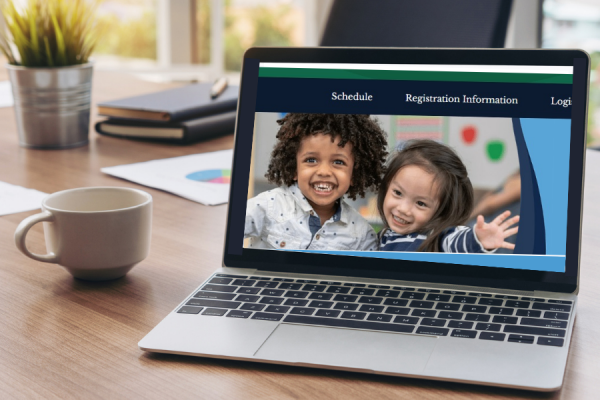
Virtual Inclusion Institute extends learning, access, and community around the world
For two days in June, early childhood professionals from across the United States and around the world logged on to continue a shared conversation about what it takes to ensure that every young child—across backgrounds and abilities—can learn, play, and grow in high-quality, inclusive early childhood settings.
The virtual-only segment of the International Early Childhood Inclusion Institute, hosted by the UNC Frank Porter Graham Child Development Institute (FPG) on June 24 and 25, extended the learning from the Institute’s May hybrid event and created new opportunities for participation for those who could not attend in person—providing another way to connect, learn, and bring evidence-informed practices back to their communities.
With 148 attendees, more than 30 presenters, and 24 sessions offered across morning and evening time blocks, the virtual event brought together participants and speakers from several countries, including the United States, Australia, New Zealand, Malaysia, Canada, China, and Japan.
Sessions explored topics, frameworks, resources, and tools that support inclusion at multiple levels—from countries and states to communities, programs, homes, and classrooms—while also centering the lived experiences of children and families.
Expanding access to inclusion-focused learning
The virtual format was designed intentionally to complement the Inclusion Institute’s in-person experience while addressing a clear need among participants who rely on virtual professional learning because of travel limitations, budget constraints, accessibility needs, or scheduling demands.
Participants highlighted the value of being able to access research-based training without travel. One attendee noted that the format was “perfect because our agency does not let me travel out of the state,” while another said, “Attending a virtual event is an easy ‘yes’ from my leadership.” Others emphasized the importance of accessibility and flexibility, including one participant who wrote, “People with disabilities who cannot fly can be included.”
For Chih-Ing Lim, PhD, a senior technical assistance specialist at FPG and co-chair of the event, the virtual-only segment reflected more than a year of thoughtful planning, input from past participants, and consultation with advisors and constituents. “The success of this virtual segment owes much to our advisory members,” said Lim, “particularly our international advisors John Forster from Australia and Elena Soukakou from Greece.”
Lim shared that they all wanted to ensure colleagues who are only able to participate virtually would have more robust options and improved support from the virtual experience. And she was both thankful for and inspired by the many colleagues who participated. “Most inspiring was the response from colleagues across the United States and internationally who stepped forward to contribute practical frameworks and resources, and rich stories from their inclusion journeys,” said Lim.
Sherri Britt Williams, MPH, who is also a senior technical assistance specialist at FPG and co-chair of the event, saw the virtual Inclusion Institute as a “wonderful extension” of the in-person experience but that, in this format, it also “brought its own energy and reminded us that the work of inclusion is happening in many different communities, contexts, and countries.”
Practical, hopeful, and relevant
Across 24 sessions, participants rated the quality, relevance, and usefulness of the sessions highly. Feedback reflected a recurring theme: the Institute offered meaningful learning for people at many points in their inclusion journey, from those new to the field to experienced practitioners looking for new resources, reflection, and inspiration.
“I came in knowing a lot about the topic, but still found the class valuable,” one participant shared. Another described a session as “a great pause” to reflect on current practice and consider new approaches.
Many participants also pointed to practical tools and evidence-based practices they could use immediately. “This training was so practical and relevant,” one attendee wrote. “I’m looking forward to using many of these EBPs.” Another participant said a session “exceeded my expectations and opened my mind to a very different way to approach my work, my thinking and framework.”
Williams said that practical application was one of the defining strengths of the virtual institute.
“What stood out to me about the virtual Institute was how practical and hopeful the sessions were,” Williams said. “Presenters offered concrete strategies, evidence-based approaches, and thoughtful frameworks that participants could take back into their own work, whether they are supporting families, coaching practitioners, preparing professionals, or leading systems change.”
Centering families, relationships, and lived experience
In addition to tools and strategies, attendees responded strongly to sessions that centered stories, representation, and family experiences. Sessions focused on fathers of children with disabilities and foster, adoptive, and kinship families helped ground the work of inclusion in relationships and everyday realities.
“I appreciate the honesty and transparency of the fathers,” one participant wrote. Another described a session as offering “beautiful stories and practical application.”
Williams said those sessions were especially meaningful because they kept the Institute connected to the strengths, priorities, and experiences of children and families. “Those sessions helped keep the work grounded in the everyday experiences, strengths, and priorities of children and families,” Williams said.
A global community committed to meaningful inclusion
The virtual Institute also underscored the global reach of early childhood inclusion work and the importance of learning across communities, contexts, and countries. To make participation possible across time zones, programming was offered in morning and evening blocks, from 8:00 a.m. to 11:00 a.m. and 6:00 p.m. to 9:00 p.m. Eastern time.
Lim said she was moved by the commitment of participants who stayed engaged across the full day of programming—some joining sessions at 5:00 a.m. in their own time zones and others attending nearly every session she hosted.
“Their energy proved contagious,” Lim said. “This experience reminded me that while our inclusion journey is long and complex, it gives me much hope that we have a growing, dedicated community committed to lifting each other up.”
Participant feedback reflected that same sense of connection and momentum. “This was one of the best conferences I have attended all year,” one attendee wrote. “Every session was amazing and I am excited to share the resources with the rest of my team.” Another shared, “I will take back what I learned into the classroom this fall.”
Continuing the momentum
For FPG, the virtual-only segment reinforced a central promise of the International Early Childhood Inclusion Institute: to create space for professionals, families, leaders, and advocates to discover evidence-informed practices, strengthen partnerships, and build more inclusive systems for young children and the adults who support them.
As Williams noted, the virtual format brought its own energy and highlighted the breadth of work happening in communities around the world. “That international exchange is one of the things that makes the Inclusion Institute so meaningful,” she said. “Together, those sessions reflected the many layers of work needed to build more inclusive early childhood systems.”
By extending access, elevating practical strategies, and strengthening a global community of inclusion-focused professionals, the virtual Inclusion Institute helped keep the learning—and the momentum—moving forward.


