


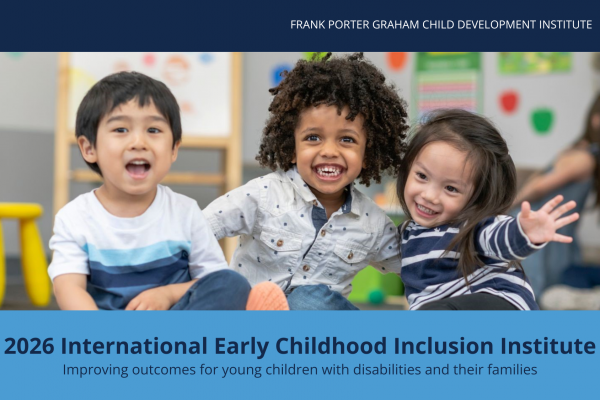
2026 International Early Childhood Inclusion Institute draws more than 300 attendees from around the globe
For young children with disabilities, inclusion begins with belonging—learning, playing, and growing alongside their peers in environments designed to support every child. For decades, the UNC Frank Porter Graham Child Development Institute (FPG) has worked with educators, families, and communities to help make that vision a reality, expanding high-quality inclusive opportunities in early childhood settings.
That work was on full display in May, when FPG hosted its 26th annual International Early Childhood Inclusion Institute. The annual event brought together more than 300 registrants, presenters, and exhibitors from across the country and around the world, all focused on supporting young children with disabilities, from birth to age 8, in inclusive environments.
Part professional learning opportunity and part community-building experience, the Institute offers practical strategies, evidence-informed resources, and opportunities for connection among professionals, caregivers, advocates, and family members committed to advancing inclusion. This year, participants could choose from three in-person pre-conference sessions, 40 in-person sessions, 11 hybrid sessions, and two virtual sessions over three days.
We asked this year’s co-chairs, Chih-Ing Lim, PhD, and Sherri Britt Williams, MPH, to share their reflections from the event—keep reading to see what they had to say. But first, we want to remind you that the International Early Childhood Inclusion Institute will be holding a virtual-only event later this month and registration is still open. Check out the current virtual session schedule to see what learning opportunities are available.
Reflections from Chih-Ing Lim
Every year at the institute, I'm both amazed and humbled by the tapestry of participants who gather: families, allied health professionals, early childhood teachers, special education teachers, child care directors, coaches, and faculty, as well as individuals with disabilities. They show up with tremendous enthusiasm and openness to learn, share, and problem solve together.
Many faces have become familiar over the years, with some having been part of this community for decades. It truly takes every thread in this tapestry to ensure access, participation, and belonging for young children with disabilities. This year's keynote speaker, Mychal Threets, a very beloved librarian and host of the Reading Rainbow, and a recently diagnosed autistic individual, reinforced this message beautifully. He reminded us of the need to listen to learn, particularly from children with disabilities, and the importance of recognizing that everyone needs support. By sharing his vulnerabilities and bringing his authentic self, he set the tone for the rest of the institute as being one that is a safe space for frank conversations, sharing of lived experiences, and being open to reframing and doing better. This May brought another milestone: a record number of first-time participants and presenters, many of whom are family members and community partners. Their fresh perspectives and voices strengthen our collective work.
Reflections from Sherri Britt Williams
The in-person Institute reminded me why this gathering matters so much. It's not just a conference where people come to learn new information. It is a place where people reconnect with their purpose, build relationships, and leave with renewed commitment to changing systems, strengthening practices, and expanding what is possible for young children with disabilities and their families. Each year, I am moved by the passion and commitment of the people who come to the Inclusion Institute. Many return year-after-year because they believe deeply in building inclusive systems and opportunities for young children with disabilities and their families. As my co-chair shared, this year, we welcomed so many first-time participants, and they brought such wonderful energy, curiosity, and excitement to the experience. One of the most powerful things about the Inclusion Institute is the sense of shared purpose it creates. People come from many different roles, communities, states, and countries, but they come together around a common belief: that we are all changemakers with a responsibility to remove barriers, strengthen supports, and expand opportunities for young children with disabilities and their families.
We were especially intentional this year about elevating the perspectives of family members throughout the Institute. Having such a strong presence of family members presenting and attending made the Institute especially meaningful. Learning from people most impacted by the barriers, supports, and opportunities within systems and communities keeps this work grounded in real experiences, real challenges, and real possibilities. One of the highlights for me was the plenary on rightful presence, agency, and self-advocacy, featuring Seena Skelton, Philip Woodward, Alex Campbell, and Amanda Kloo. The session was powerful because it centered the perspectives and lived experiences of people with disabilities. It reminded us that inclusion in the early years is not just about access to a classroom or program. It's about nurturing identity, confidence, self-advocacy, agency, and possibility from the very beginning.
I also want to recognize my co-chair, Chih-Ing Lim. I am deeply grateful for her leadership, wisdom, and steady commitment to the Inclusion Institute. So much of what she does happens behind the scenes, but it is essential to the quality and success of the Institute. I continue to be inspired by the way she holds so many moving pieces with care, thoughtfulness, and clarity.
Although the in-person Institute has wrapped up, I’m also excited about our virtual-only event on June 24 and 25. We have a strong lineup of additional sessions, including new content and presenters from across the country and around the world, along with a few popular sessions from the in-person Institute. It is a wonderful way to extend the learning and keep the momentum going.


