


FPG investigators help shape revised national position statement on early childhood inclusion
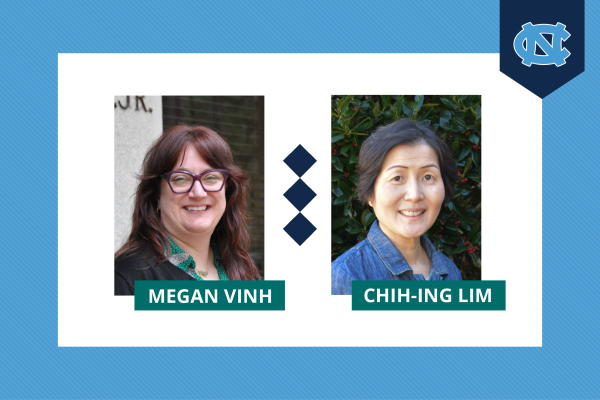
The Division for Early Childhood (DEC) and the National Association for the Education of Young Children (NAEYC) have released their revised joint position statement on early childhood inclusion. Two investigators from the UNC Frank Porter Graham Child Development Institute (FPG) played central roles in its development. Megan Vinh, PhD, led the national workgroup that developed the statement, and Chih-Ing Lim, PhD, was part of that workgroup. Both are senior technical assistance specialists at FPG.
Announced in October 2026, Early Childhood Inclusion: A Joint Position Statement of DEC and NAEYC updates the 2009 version that has guided the field for more than a decade. It defines early childhood inclusion as the rightful presence of each and every young child with a disability and their families in all early childhood education environments. It also emphasizes that children with disabilities and their families have the right to belong in every early childhood environment, space, and community, with their strengths affirmed and their needs supported.
The new statement keeps the original goal of building a shared understanding of inclusion. It also grounds inclusion as a right and an ethical obligation, and it calls for putting inclusion into practice every day, in how those within the field of early education act, decide, partner, and change. Among the key updates, the revised position statement promotes a future where inclusion is essential, calling on the field to share responsibility for disrupting ableist systems, practices, and communities in line with commitments to racial equity, ethical practice, and developmentally appropriate practice. It updates the definition to make clear that inclusion is a right of young children with disabilities, adds belonging as a key characteristic, and clarifies that the support characteristic focuses on system-level supports. It also adds a call to action asking everyone to bring the statement to life, along with new appendices that include a workgroup members list, a revision timeline, a glossary, and supporting research.
FPG's contribution to the revision
Vinh directs the Early Childhood Technical Assistance Center (ECTA) and co-directs the STEM Innovation for Inclusion in Early Education (STEMIE) Center at FPG. She is a former member of the DEC Executive Board. Her work focuses on improving access, experiences, and outcomes for children with disabilities in the early care and education system. She led the national workgroup that guided the revision.
“It was an honor to lead this workgroup and to get to collaborate with a group so dedicated to the rightful presence of young children with disabilities,” said Vinh. “I am so excited to finally see our hard work out in the field and can't wait to see how people use this statement to further the commitment to access, participation, and belonging for children with disabilities."
“It was an honor to lead this workgroup and to get to collaborate with a group so dedicated to the rightful presence of young children with disabilities,” said Vinh. “I am so excited to finally see our hard work out in the field and can't wait to see how people use this statement to further the commitment to access, participation, and belonging for children with disabilities."
Lim, who co-directs the STEMIE Center with Vinh and co-chairs FPG’s annual International Early Childhood Inclusion Institute, was a member of the workgroup that supported gathering, analyzing, and synthesizing input from the field. The two also frequently work together on inclusion efforts abroad, including a partnership with the National Institute of Education at Nanyang Technological University in Singapore.
“The response from the early childhood and early childhood special education communities to contribute to the revision of the statement has been humbling and shows the field's strong commitment to inclusion," said Lim. "Throughout our listening sessions and survey responses, we heard how much the 2009 statement has meant to people's work. The defining features: access, participation, and supports really stuck with them. But it was also clear that a revision was needed. Over the past decade, we have learned a great deal from the wisdom of inclusion advocates, families, and the disability community about rightful presence and belonging. The revised statement shows how we can move forward both as a collective and as individuals to affirm each and every child through our actions and decisions."
"Over the past decade, we have learned a great deal from the wisdom of inclusion advocates, families, and the disability community about rightful presence and belonging. The revised statement shows how we can move forward both as a collective and as individuals to affirm each and every child through our actions and decisions," said Lim.
Both investigators are proud of the work and excited to see it released.
Building on FPG's earlier work
This is not the first time FPG has helped shape the field's shared definition of inclusion. The 2009 DEC-NAEYC joint position statement was also led by FPG colleagues, including Camille Catlett, Virginia Buysse, and Heidi Hollingsworth. It addressed the lack of a shared national definition of early childhood inclusion and offered a blueprint for identifying the key components of high-quality inclusive programs.
From the 2009 statement to the 2026 revision, FPG's leadership has helped the field build a common understanding of what inclusion means and what it takes to put it into practice. Read the full 2026 joint position statement and its related resources on the DEC website.


