


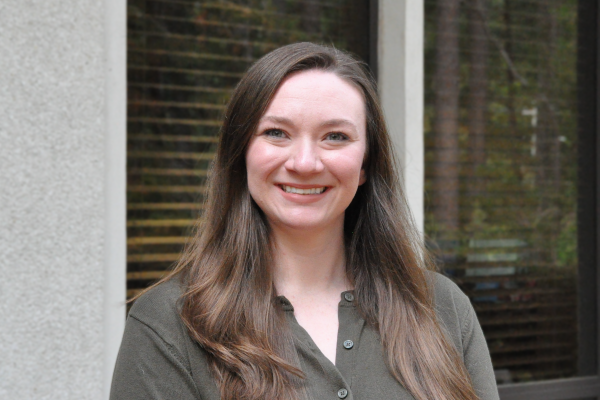
Kylie Garber receives 2026 Abecedarian Award
The UNC Frank Porter Graham Child Development Institute (FPG) is pleased to announce that FPG Research Scientist Kylie Garber, PhD, has received the 2026 Abecedarian Award, an honor recognizing early career research by an FPG staff member that is scientifically rigorous and addresses an issue of significant social concern.
Established in 2013 by Joseph Sparling, Craig Ramey, and Sharon Ramey, the Abecedarian Award Endowment Fund commemorates FPG’s groundbreaking Abecedarian longitudinal studies—the Abecedarian Project, Project CARE, and the Infant Health and Development Program. The inaugural award was presented in 2016 to Mary Bratsch-Hines in conjunction with FPG’s 50th anniversary. Recent recipients include Jessica Amsbary (2025), Hsiu-wen Yang (2023), Sandra Soliday Hong (2021), Ann Sam (2020), Jessica Dykstra Steinbrenner (2019), Irina Mokrova (2018), and Kara Hume (2017).
For Garber, the award represents both a meaningful career milestone and a connection to a body of research that has deeply shaped her own scholarly path.
“The Abecedarian Project has been central to the development of my research program, shaping both the questions I ask and the approaches I use,” Garber said. “My work builds on its foundational insights into how language-rich, responsive caregiving environments drive long-term development, and my future research aims to extend and preserve this legacy within a modern early care and education context.”
“The Abecedarian Project has been central to the development of my research program, shaping both the questions I ask and the approaches I use,” Garber said. “My work builds on its foundational insights into how language-rich, responsive caregiving environments drive long-term development, and my future research aims to extend and preserve this legacy within a modern early care and education context.”
Garber spent much of graduate school working with Abecedarian data, and the study ultimately became part of her dissertation. During the 45-year follow-up project, she contributed to a paper examining mediators of treatment effects on adult outcomes. Around that time, researchers were conducting retrospective interviews with Abecedarian and Perry Preschool teachers—work that eventually helped inform Garber’s dissertation, a mixed-methods study using findings from those interviews to inform a more targeted mediation analysis.
“The Abecedarian project has played a huge role in shaping my professional career, and I hope to carry its legacy forward through my own work,” Garber said.
Garber examined the role of language-rich, responsive interactions embedded throughout daily classroom routines. Teachers described frequent, complex conversations as central to their practice. Guided by those insights, Garber demonstrated that children’s verbal skills at school entry were the primary mechanism linking early intervention to higher educational attainment and, indirectly, adult economic outcomes.
Garber recently published the work and presented it at the 2026 American Educational Research Association annual conference alongside colleagues conducting parallel work with Perry Preschool teachers. Centering teachers’ voices, she said, was especially meaningful.
“The Abecedarian project has played a huge role in shaping my professional career, and I hope to carry its legacy forward through my own work,” Garber said.
Building on a legacy of early childhood research
Garber’s current work includes two state partnerships focused on early care and education. In North Carolina, she is helping child care providers transition to the state’s new Quality Rating and Improvement System. In Georgia, she is preparing to evaluate the Rising Pre-K Summer Transition Program next summer.
With support from the Abecedarian Award, Garber plans to launch a new line of research inspired by retrospective interviews with Abecedarian teachers and focused on how today’s infant and toddler teachers understand and enact classroom quality. She plans to survey North Carolina infant and toddler teachers about their teaching practices, curriculum use, and professional development and coaching experiences, with the goal of comparing contemporary practices to those used in the original Abecedarian classrooms.
Her motivation, she said, is rooted in a commitment to helping children—and the adults who care for them—thrive in school and later in life. Becoming a parent has deepened that commitment.
“Seeing my daughter grow and change so rapidly in the past two years has given me a new appreciation for how critical early childhood is,” Garber said. Looking ahead, she hopes to continue conducting research that informs practice and policy while forging her own path as an early care and education researcher. She credits the mentorship of FPG Senior Research Scientist Sandra Soliday Hong, PhD, and FPG’s early career mentoring group with helping her grow in confidence as a research scientist. Hong praised Garber’s work, noting that her “commitment to preserving and extending the Abecedarian legacy represents important and impactful work that is highly deserving of support through the Abecedarian Award.”


