


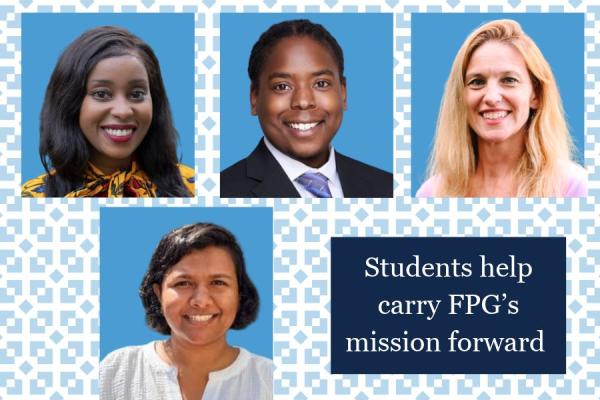
Students help carry FPG’s mission forward through research, partnership, and purpose
Across our Institute, students contribute to research, evaluation, implementation, and partnership in ways that strengthen our work with children, families, practitioners, and communities. This year’s student profile series highlighted four emerging and established scholars—Menna Mburi, TK Musa, Aditi Nambiar, and Susie Welty—whose paths to FPG differ, but whose stories share a clear throughline: Each found at FPG a place to connect rigorous inquiry with real-world impact.
Menna Mburi
For Menna Mburi, a PhD candidate in public policy at Carolina, FPG provided a home for scholarship rooted in racial equity, community partnership, and the lived experiences of Black immigrant families. As a graduate research assistant with FPG’s Equity Research Action Coalition (ERAC), Mburi worked on projects focused on advancing racial equity for children and families from socioeconomically disadvantaged backgrounds. Her contributions included evaluating coaching models for educators in under-resourced child care settings and partnering with early childhood professionals to address systemic racial disparities in hiring, pay, and professional opportunity. Her dissertation extended that commitment by examining how Medicaid and CHIP eligibility policies affect maternal health care access and outcomes among Black immigrant mothers and infants.
Mburi’s time at FPG helped clarify the kind of scholar she wants to become: one who brings together quantitative analysis, critical frameworks, community expertise, and policy engagement. Her first research grant, awarded through the Robert Wood Johnson Foundation’s Policies for Action program with ERAC Founding Director Iheoma Iruka, PhD, has been especially meaningful. The grant supports research on policies that can strengthen the social, economic, and civic inclusion of immigrant children and families, while bringing greater visibility to the stories, strengths, and needs of Black immigrant communities.
TK Musa
TK Musa, a former ERAC graduate research assistant who completed his PhD in public policy at Carolina, also found at FPG a model for research that moves beyond academic audiences. Born and raised in Malawi, Musa’s scholarship centers on educational equity, child development, and the cultural and economic systems that shape learning opportunities for Black children across global contexts. At FPG, he contributed to mixed-methods research, qualitative interviewing, data analysis, project coordination, and the translation of findings into tools for educators, families, and policymakers.
Musa’s FPG work included studies of African-centered early childhood education, family decision-making, implementation research, and community partnerships. He contributed to a Spencer Foundation proposal examining why Black families choose African-centered early learning programs and how those experiences shape children’s academic and socio-emotional development. That work aligned closely with his dissertation, Cultural and Economic Foundations of Educational Equity in the African Diaspora, which explored how culturally affirming learning environments, economic resources, and community priorities intersect to shape educational opportunity. Now a research analyst at the National Center on Education and the Economy, Musa credits FPG with helping him see how evidence can inform policy, strengthen professional practice, and support large-scale systems improvement.
Aditi Nambiar
Aditi Nambiar’s FPG experience reflects another dimension of the Institute’s student impact: applied evaluation, data systems, and capacity building. A recent graduate of the Master of Public Health program at the UNC Gillings School of Global Public Health, Nambiar has worked with Senior Researcher Sandra Soliday Hong, PhD, on pre-K evaluation projects. Her responsibilities have included participant recruitment, survey development, focus group scheduling, report writing, and support for large-scale data collection across diverse early childhood education settings.
Through this work, Nambiar has gained hands-on experience with statewide evaluation, implementation frameworks, logic models, data reporting, and research communication. She is particularly proud of strengthening her technical expertise in data collection tracking systems, including helping design and maintain trackers that support complex project operations and later leading an Excel tracker training for the FPG team. Her work has deepened her interest in monitoring and evaluation as a career path and connected her public health interests in violence prevention, child maltreatment prevention, implementation science, and community capacity building with FPG’s broader mission to improve child and family well-being.
Susie Welty
Susie Welty brings a different stage of professional experience to FPG, but a similar commitment to using research in service of families and communities. A Doctor of Public Health student at Gillings, Welty has more than two decades of global health experience in academic and public health settings, including work on HIV care and treatment data systems, surveillance systems in Tanzania, and COVID-19 contact tracing and training efforts in California. Born and raised in Ecuador, she traces her commitment to health equity to early experiences seeing Indigenous Quechua communities denied access to health care.
Welty is now conducting dissertation work with FPG Senior Research Scientist Ann Sam, PhD, on AFIRM-AI, a project focused on the responsible use of artificial intelligence to support educators, practitioners, autistic individuals, and their families. Her personal advocacy for autistic individuals and her professional interest in AI for social impact converged with the project’s goals. At FPG, she has found an inclusive team that values lived experience and responsible innovation—an environment that allows her to bring together public health, autism, technology, and social impact as she looks toward future work at the intersection of AI and health.
FPG as a training ground for the next generation
Taken together, these four stories offer a rich portrait of how students and trainees help advance FPG’s work while being shaped by it. Mburi, Musa, Nambiar, and Welty each describe FPG as a place where research is not an endpoint, but a bridge connecting scholarship to policy, practice, implementation, and community change. Their work spans maternal and child health, Black immigrant family well-being, African-centered education, pre-K evaluation, violence prevention, autism, public health, and responsible AI. Yet across those varied areas, shared themes emerge: the importance of centering communities and lived experience; the value of interdisciplinary collaboration; the need to translate research into practical tools and policy-relevant insights; and the power of mentorship and team-based learning.
Their stories also underscore FPG’s role as a training ground for the next generation of scholars, practitioners, evaluators, and leaders. At FPG, students do more than observe research; they help design studies, build systems, engage partners, develop tools, write grants, analyze data, and communicate findings. In doing so, they contribute directly to FPG’s mission while gaining the skills, confidence, and vision to carry that mission forward. Whether advancing racial equity, improving education systems, strengthening early childhood programs, or exploring the responsible use of emerging technologies, these students demonstrate how FPG’s impact grows through the people it trains, mentors, and inspires.


